In the ancient wisdom of yogic philosophy, Prana is often considered the very essence of life and the vital energy that animates all forms of life.
This Sanskrit word, when translated, means “life force“, and is the cornerstone of many spiritual and physical practices in traditions across India.
Traditionally, this system is delineated into five primary streams or “Vayus” – Prana, Apana, Vyana, Udana, and Samana – each with distinct functions and flows within the body.
However, the subtleties of Pranic energy extend beyond these five principal streams. Ancillary to them are the five Upa-Pranas, lesser-known yet equally significant forces that support and refine our life force.
Together, understanding the interplay of these ten energies offers profound insights into our existence and provides a blueprint for holistic well-being.
Table of Contents
Toggle
What is Prana?
Prana, in the context of yoga, transcends the simple act of breathing to encompass the life-force energy that permeates all living things.
Prana is the fundamental principle that sustains life and the functioning of the physical body, as well as the mind and consciousness. It is the bridge between the material and the spiritual, influencing our existence at every level. (It is very similar to the Chinese concept of Qi from Traditional Chinese Medicine.)
The origins of Prana can be traced back to the ancient Vedas, the oldest texts of Hindu philosophy, where it is mentioned as a cosmic force responsible for all dynamic activities in the universe.
In the human body, Prana is believed to flow through an intricate network of channels called nadis (like meridians). While there are said to be thousands of nadis, three primary ones are highlighted in yogic texts: the Sushumna, Ida, and Pingala. These channels facilitate the flow of energy from the base of the spine to the crown of the head, intersecting with various chakras.
Chakras, each correlating to specific physical, emotional, and spiritual functions, serve as hubs for Prana, distributing it throughout the body. When Prana flows freely, the chakras are aligned and balanced, leading to a state of health and harmony. Conversely, when the flow is blocked or unbalanced, it can lead to physical illness or emotional disturbances.
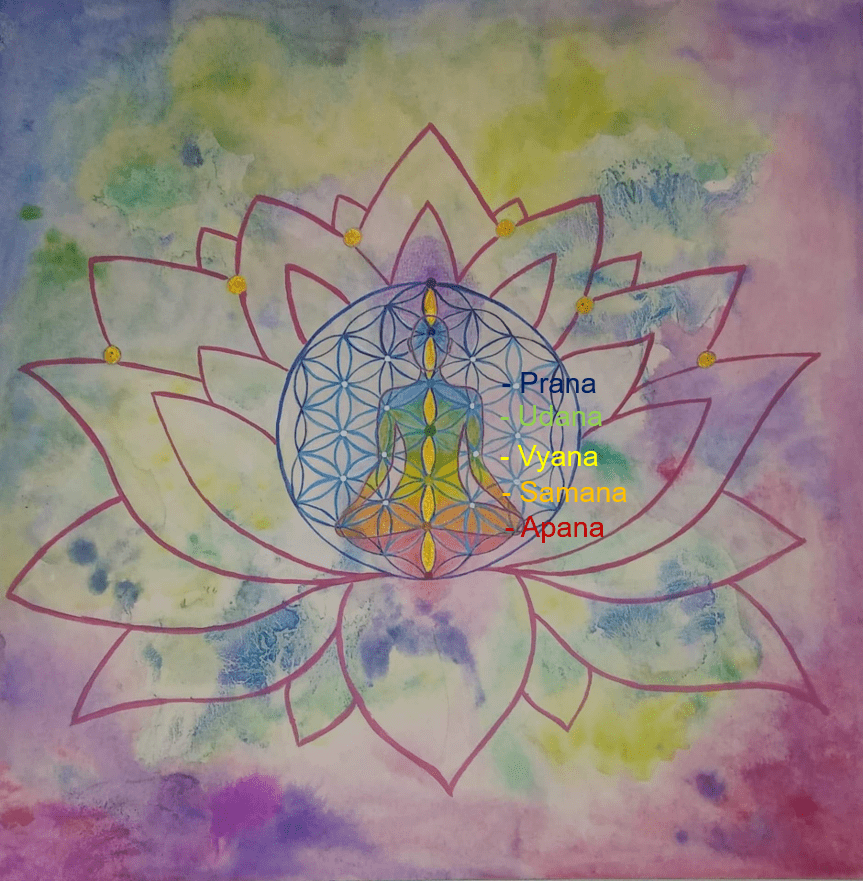
5 Types of Prana
1. Prana Vayu
In Sanskrit, “Vayu” translates to “wind,” indicating movement, thus, Prana Vayu is a significant force that drives the movement of energy within the body.
Prana Vayu is centered in the chest and head and primarily moves inwards and upwards. It resides in the region of the heart, influencing the thoracic area and the respiratory organs. Its upward movement is essential for the intake of air and prana from the environment.
Functions and Significance
The functions of Prana Vayu are critical to sustaining life. It governs the intake of air, food, sensations, and experiences. It is responsible for the respiratory process, including the inhalation which brings oxygen into the body and prana into the energy system. On a subtle level, it’s also connected to the intake of sensory experiences and the initial processing of information.
Prana Vayu plays a key role in the vitality and immunity of an individual. It acts as the fundamental energy that propels the function of the other Vayus. Its proper flow ensures that the body can assimilate prana from the breath and nourishment from food. It is associated with the functions of the lungs, heart, and also with the brain, impacting concentration, cognition, and the functioning of the senses.
2. Apana Vayu
Where Prana Vayu is associated with the reception of energy, Apana Vayu is principally involved in the expulsion of energy.
Apana Vayu is located in the lower abdomen and pelvic region, and its flow is downward and outward.
This Vayu is seated below the navel and encompasses the area of the large intestine, rectum, kidneys, and reproductive organs. It governs the downward and eliminative processes such as the excretion of waste, the release of menstrual fluid, and the expulsion of semen.
Functions and Significance
The main function of Apana Vayu is the removal of toxins and waste products from the body. It’s crucial for maintaining the health of the eliminative organs, ensuring that the body rids itself of substances that can cause harm if they accumulate. Apana Vayu is also instrumental during childbirth, as it aids in the downward movement required to deliver a baby.
On a subtler level, Apana Vayu is responsible for the release of negative sensory, emotional, and mental experiences. Just as it allows the physical body to discard what is no longer needed, Apana Vayu also helps to expel negative energies and emotions to prevent them from causing blockages in the body’s pranic flow.
In the context of energy balance, Apana Vayu serves as the counterforce to Prana Vayu. While Prana Vayu draws energy into the body, Apana Vayu aids in its release and grounding, contributing to a natural balance within the body’s energetic system. This balance is essential for physical health and emotional well-being.
3. Samana Vayu
Samana Vayu stands distinct among the five vayus for its central role in the assimilation and distribution of prana throughout the body. Its balancing action is crucial for maintaining the equilibrium of pranic flows.
Samana Vayu is situated at the center of the body in the area of the third chakra, Manipura, located around the navel and the solar plexus. Its movement is neither outward nor inward but rather a churning and balancing motion. It operates in the gastrointestinal tract, especially the stomach and the small intestines, which are the primary sites for digestion and assimilation.
Functions and Significance
The principal function of Samana Vayu is the digestion and assimilation of food, ensuring that nutrients are properly extracted and the waste is prepared for elimination by Apana Vayu. It works in tandem with the digestive fires (agni) to break down food, aiding in the conversion of food into energy and building blocks for the body.
On an energetic level, Samana Vayu is responsible for the absorption and assimilation of prana from food and the environment. It helps in distributing this energy to every cell and system of the body. This distribution is crucial for maintaining the body’s homeostasis and for supporting the functions of the other vayus.
4. Udana Vayu
The Udana Vayu is primarily located in the throat and head regions. Its direction of flow is upward, moving from the center of the body along the spine to the crown of the head. It is responsible for the upward flow of energy that influences speech, self-expression, and the movement of thoughts and emotions.
Functions and Significance
The functions of Udana Vayu are diverse. It is vital for the regulation of speech, expression, and vocalization. It controls the muscles and organs involved in swallowing, and it also oversees the action of coughing, which is the body’s way of clearing the respiratory passages.
Udana Vayu’s significance extends to the realm of spiritual growth. It is said to govern the flow of energy that elevates consciousness to higher levels. In this capacity, it is closely linked with spiritual practices that involve the throat chakra, Vishuddha, and the third eye chakra, Ajna.
5. Vyana Vayu
Vyana Vayu is the last of the five primary pranas, and it is essential for the movement and strength of the entire body.
Vyana Vayu is pervasive, permeating the entire body, but it is particularly centered in the limbs and extends throughout the entire physical framework. Unlike the other vayus which have specific directional flows, Vyana Vayu moves outward from the core to the periphery. It governs the circulation of nutrients and energy to every cell and the movement of limbs.
Functions and Significance
The functions of Vyana Vayu include regulating the circulatory system, ensuring that blood, nutrients, and energy reach all parts of the body. It is also responsible for muscle movement and controls the contraction and relaxation of muscles.
The significance of Vyana Vayu extends to the coordination of all the other vayus, ensuring they work in harmony. It maintains balance in the body and mind, helping to integrate the functions of the pranas, which in turn stabilizes the individual’s energy system. Vyana Vayu is also vital for the response mechanisms of the body, such as reflex actions.
In a broader sense, Vyana Vayu is essential for the synchronization of mind and body activities, aiding in activities requiring dexterity and coordination. On a subtle level, it is associated with the nervous system and the transmission of nerve impulses.
Here is table to summarize the 5 main Pranas:
|
Prana
|
Location in Body
|
Primary Functions
|
Direction of Flow
|
|---|---|---|---|
|
Prana Vayu
|
Chest and head
|
Respiration, intake of air and prana, swallowing, and the functioning of the senses
|
Inward and upward
|
|
Apana Vayu
|
Lower abdomen
|
Elimination of waste, reproductive functions, and downward movement of energy
|
Downward and outward
|
|
Samana Vayu
|
Navel area
|
Digestion, assimilation of food, and the balance of prana and apana
|
From the periphery to the center
|
|
Udana Vayu
|
Throat and upward to the head
|
Speech, expression, growth, and upward energy movements
|
Upward
|
|
Vyana Vayu
|
Throughout the entire body
|
Circulation of blood, movement of limbs, and pervading the whole body
|
Outward from the center to the periphery
|
5 Types of Upa-Prana
The Upa-Pranas are considered subsidiary to the five main Pranas. While the main Pranas are responsible for major bodily functions, the Upa-Pranas play a supporting role, managing more specific and subtle activities. They are crucial for the optimal functioning of various physiological processes and are also intertwined with our emotional and mental states.
The Upa-Pranas are involved in activities such as the blinking of eyes, yawning, sneezing, and other reflex actions. They assist the main Pranas by ensuring that these subtler functions, often taken for granted, are performed efficiently and effortlessly.
1. Naga
Naga’s primary function is to facilitate the release of gas from the stomach. It is the energetic force that controls burping, which are natural processes to expel excess air swallowed during eating or drinking. This function is crucial because if the air is not expelled, it can lead to discomfort, such as bloating or abdominal pain, and can interfere with the proper digestion of food.
The activity of Naga is a subtle but vital process that reflects the body’s intelligence to maintain balance and comfort. It’s not just about relieving physical discomfort but also about ensuring that the digestive process is not hindered by the presence of unnecessary gases.
In the broader perspective of pranic energy management, Naga helps in maintaining the proper flow of energy within the body. When there is an accumulation of air within the digestive tract, it can disrupt the flow of the main Pranas, particularly Samana Vayu, which is closely related to digestion. By releasing excess air, Naga supports Samana Vayu in its role of processing and distributing nutrients and energy.
2. Kurma
Kurma has the critical function of controlling and stabilizing the movement of the eyes. This Upa-Prana enables the eyelids to blink and the eyeballs to move smoothly. The blinking reflex is essential as it helps to lubricate and protect the eyes by spreading tears evenly across the surface, which prevents dryness and removes dust and other irritants from the cornea and conjunctiva.
The significance of Kurma lies in its role in maintaining the health and functionality of the eyes, which are not only vital for vision but also serve as a gateway for processing external stimuli and are closely linked to the brain and nervous system. Proper eye function, facilitated by Kurma, is essential for perception, awareness of one’s surroundings, and coordination with other sensory organs.
On a deeper level, Kurma’s influence on eye movements is also related to concentration and mental focus. When the eyes are steady and controlled, it can significantly enhance one’s ability to concentrate during meditation or any focused work. This is why in many meditative practices, controlling the gaze (known as “drishti” in yoga) is a foundational technique for cultivating concentration.
3. Devadatta
The primary function of Devadatta is to regulate the mechanism of yawning. Yawning is an involuntary action that often occurs when the body is tired or when it transitions between states of alertness and rest. It is a deep inhalation of air followed by a slower exhalation, which can lead to a feeling of increased alertness or readiness for sleep.
In some yogic practices, the act of yawning is seen as a way to release excess energy from the head and to calm the mind.
4. Krikala
Krikala’s main function is to trigger the sneeze reflex. Sneezing is a sudden, forceful expulsion of air from the lungs through the nose and mouth. It is a defensive mechanism the body uses to clear the nasal cavity of irritants, such as dust, pollen, or foreign particles, as well as pathogens like viruses and bacteria.
By facilitating sneezing, Krikala helps to protect the respiratory system by expelling irritants and potentially harmful microorganisms. This action helps to prevent the onset of illness by clearing unwanted particles before they can move deeper into the respiratory tract.
On a more subtle level, the act of sneezing can sometimes be associated with a sudden release of stagnant energy within the body. In some cultural beliefs, sneezing is considered a good omen that the body is going through a minor energetic reset.
5. Dhananjaya
Dhananjaya is unique among the Upa-Pranas because it is believed to be the one that does not leave the body upon death.
Its function is closely related to the retention of life force and the operation of certain permanent reflexes, such as the dilation of the cardiac sphincter and the opening of the heart valves. Furthermore, Dhananjaya is involved in the process of inflation and deflation of the lungs, not just during breathing, but also in terms of retaining the primary life force within the body after the breathing process has ceased.
It ensures that even in the absence of active respiration, the vital organs, particularly the heart, can still function for a short period. This might have implications for life-supporting reflex actions and is perhaps why it is associated with a persistent presence, even at the threshold of life and death.
From a broader spiritual perspective, Dhananjaya can be seen as symbolic of the indelible life energy that characterizes existence. Its continuous function reflects the yogic understanding that life force, or prana, is eternal and transcends the physical cessation of bodily functions.
How to Cultivate and Balance Prana
Cultivating and balancing Prana is a central aim in yogic practices. Through pranayama (breathing exercises), dietary choices, lifestyle adjustments, and meditation, one can enhance the flow and balance of Prana within the body.

Pranayama
Nadi Shodhana (Alternate Nostril Breathing): Balances left and right brain hemispheres, harmonizes Prana and Apana, and calms the mind.
Kapalabhati (Skull Shining Breath): Stimulates the brain, clears the nasal passages, and strengthens the digestive system, thus influencing Samana Vayu and Krikala.
Bhastrika (Bellows Breath): Increases oxygen supply to the body, energizes the system, and improves the flow of Vyana Vayu.
Sitali/Sitkari (Cooling Breaths): Cools the body, calms the mind, and supports Udana Vayu by soothing the throat area.
Asana (Yoga Postures): Specific asanas can be practiced to target the flow of different Pranas. For instance, forward bends may encourage the flow of Apana Vayu, whereas backbends are beneficial for Prana Vayu.
Diet
Sattvic Diet: Consuming fresh, light, and nutrient-rich foods that are easy to digest, thereby supporting the functions of Samana Vayu and enhancing overall energy.
Routine: Adhering to a daily routine that includes waking up and sleeping at consistent times, which helps regulate Prana and is beneficial for Dhananjaya.
Moderation: Practicing moderation in all activities, including eating, working, and entertainment, supports a balanced flow of Prana.

Mindfulness
Daily Meditation: Spending time in meditation daily can significantly improve the quality of Prana, leading to enhanced mental clarity and a balanced emotional state.
Mindfulness Practices: Being present in the moment and conscious of breathing helps in the regulation of Prana throughout the day.