
History of the Evzones
In the sprawling chronicles of Greece, from the mythologies of gods and heroes to the shifting sands of politics and wars, there exists a unique chapter dedicated to a select group of men known as the Evzones.
The Evzones, also known as Tsoliades, trace their roots back to the Byzantine era. Originally, these mountain fighters were known for their exceptional combat skills and agility. During the Ottoman rule, their reputation gained prominence as they were among the fierce guerrilla fighters who resisted the occupation.
As time evolved, so did the role of the Evzones. From being mountain warriors, they transitioned into elite light infantry units. Their legendary status was further cemented during World War I and the Balkan Wars, where they displayed unparalleled bravery. In the Second World War, they again stood at the front lines, defending Greek soil against the Axis Powers.
Post the wars, the Evzones were appointed as the Presidential Guard, a role they proudly serve to this day. Stationed at the Tomb of the Unknown Soldier in Athens, they have transformed from military units to becoming living symbols of the Greek state.
What is the Meaning of Evzone?
The term “Evzone” itself stems from the Greek words “ev”, meaning “well“, and “zoni”, meaning “belt“, symbolizing the “well-fitted” man, a reference both to their physical fitness and their iconic attire.
Becoming an Evzone
The very selection and training process to become an Evzone is nothing short of rigorous. One must carry the dedication, discipline, and resilience that the role demands. Afterall, to be an Evzone is to be an embodiment of the best Greece has to offer.
Criteria for Selection
-
Height: One of the primary criteria is stature. An Evzone traditionally stands tall, with the minimum height requirement being 1.87 m (approximately 6 ft 2 in). This uniform height ensures a synchronized, imposing presence during their ceremonial duties.
-
Faith: Given that the role of an Evzone carries not just military but also cultural and religious symbolism, candidates are required to be of the Orthodox Christian faith, speficially the Greek Orthodoxy, aligning with the predominant religious belief of Greece.
-
Physical Fitness: A prospective Evzone undergoes rigorous physical testing. Given the demands of the role, especially standing for extended periods, core strength, stamina, and overall physical endurance are critically assessed.
-
Mental Fitness: More than just the physical, it’s the mental fortitude that sets an Evzone apart. Psychological evaluations ensure that the candidates can handle the pressures of the job, from the intense scrutiny of the public gaze to the weight of representing a nation’s history and pride.
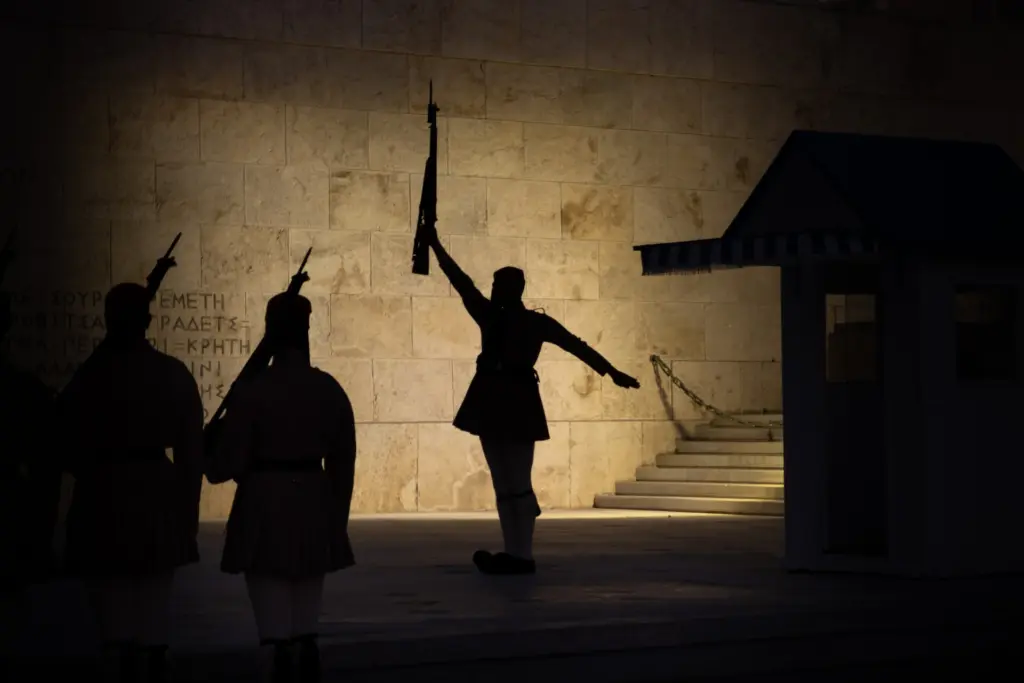
Demanding Training
The Evzone’s duty is the art of standing still—a task far more daunting than it appears.
Training begins modestly, with recruits learning to stand motionless for 5 minutes. Gradually, the duration increases, pushing their limits both physically and mentally. A culmination of this training sees them standing sentinel, unyielding, for stretches of 2 to 3 hours, come rain or shine. They don’t even blink! When asked questions, they can blink once for “yes and twice for “no.”
Additionally, their slow, synchronized movements during changing of the guard require precision, balance, and immense concentration, all of which are honed during this rigorous training phase.
Such an exhaustive selection and training process naturally results in many falling by the wayside.
It’s reported that up to 50% of aspirants do not make the final cut. The reasons for this high attrition rate are manifold: from physical injuries due to the strain of prolonged standing and marching, mental challenges brought about by the monotony and intense scrutiny, to the sheer weight of the responsibility that wearing the Evzone uniform entails.
How Much Do Greek Evzones Get Paid?
Though their discipline and service might suggest otherwise, the Evzones are not paid a lavish salary. In fact, they receive the same compensation as all other conscripts in the Greek armed forces, which is around 8 EUR a month!
This low pay rate highlights the dedication and sense of duty these young men feel towards their country. Their commitment isn’t driven by financial rewards but by the honor of representing their nation and honoring its history.
Symbolism of the Evzone Uniform
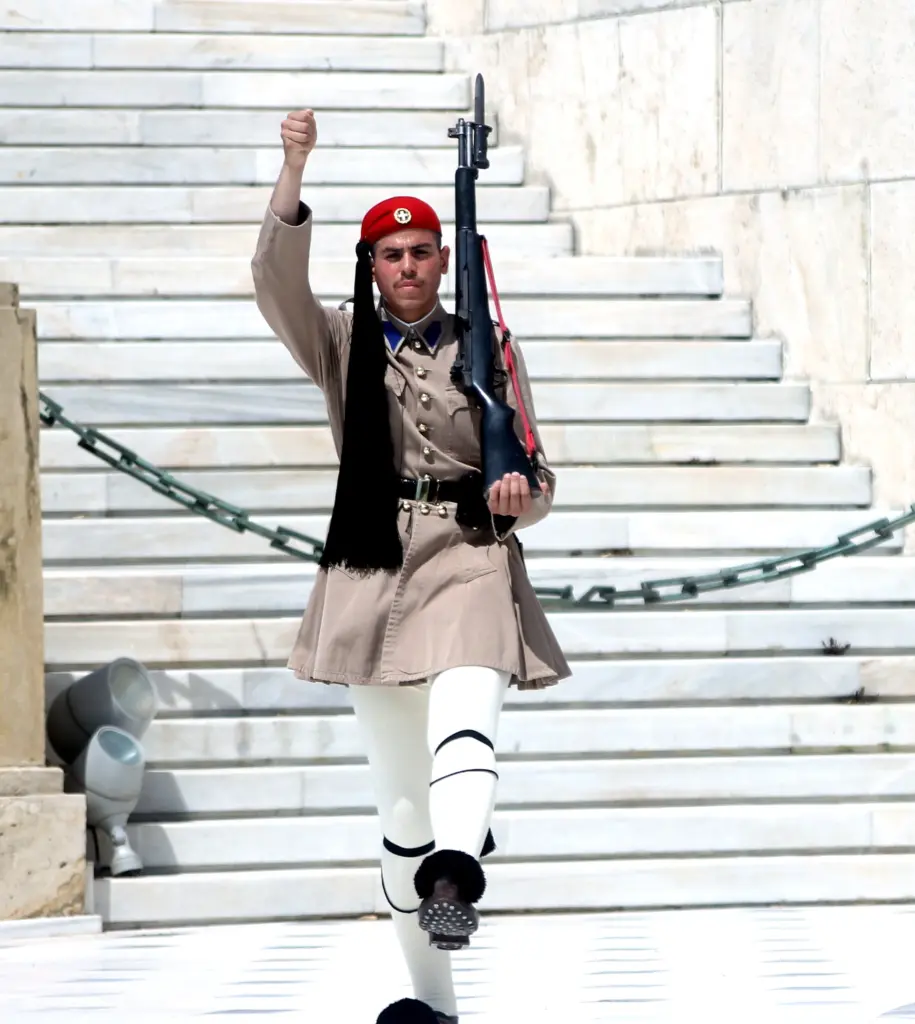
The uniform of the Evzones is not just a piece of clothing; it carries profound symbolism, representing various aspects of Greek history, culture, and religious beliefs. Each element of the uniform tells a story of its own.
The labor-intensive creation process for these uniforms emphasizes their value and significance. The fact that they are largely handmade, taking up to 6 months to craft, shows the dedication and respect accorded to maintaining tradition and ensuring that every detail is honored.

Fario
The Fario, commonly known as a fez, is a hat with a cylindrical shape, typically made of felt, and comes with a long black tassel that hangs off the side.
The color of the Fario is a deep red. The red symbolizes the blood that was spilled by Greek soldiers throughout various struggles, most notably during the Greek War of Independence against the Ottoman Empire which spanned from 1821 to 1829.
The long black tassel that dangles from the Fario is said to represent the tears shed for those who sacrificed their lives for Greece.
Fermeli
The Fermeli is the waistcoat and it’s crafted exclusively from wool. The embroidery is so finely done that the multitude of stitching holes remains hidden on the reverse side, ensuring a flawless appearance on the front. This process can take from several months to up to 10 years!
Beyond its aesthetic and craftsmanship, the Fermeli serves as an identifier within the Evzones’ ranks. Delicate stripes placed at the back right tail of the waistcoat distinguish the wearer’s rank. While a single stripe denotes a Corporal and two stripes signify a Sergeant, the Fermeli of a Private is devoid of these markers.

Fustanella
The Fustanella is a traditional pleated skirt worn by men. Its origins trace back to ancient Greece, with a version of it being worn by warriors in the classical period. Over time, the design has evolved, and by the time of the Ottoman Empire, it became widely recognized as a representation of Balkan and Greek attire.
The most striking aspect of the Fustanella is the sheer number of pleats it contains. Traditionally, the Fustanella of an Evzone has 400 pleats. Each pleat symbolically represents a year of the 400-year Ottoman occupation of Greece.
The coloration of the Fustanella further reinforces national pride. The stark white of the skirt represents purity and freedom, whereas the blue details the colors of the Greek flag.
Ypodetes
The Ypodetes is the voluminously wide-sleeved white shirt. As the Evzones march, the broad sleeves of the Ypodetes flare, creating a captivating visual.
This flaring movement is thought to symbolize the purity of the national purpose, drawing a connection between the wearer and the lofty ideals they represent.

Tsarouchia
The Tsarouchia are one of the most distinct elements of the Evzones’ uniform. These shoes, often described as clogs, weigh up to 3 kg (6.6 lb) each! The base of the shoe is made from cowhide and over 300 hand stitches are used to hold each shoe together.
A prominent feature of the Tsarouchia is the 60 nails embedded in the sole. While they play a crucial role in prolonging the shoe’s lifespan on the rough surfaces of urban and ceremonial areas, they also produce a characteristic sound during marches and guard changes. The stomp of the feet during their marching is done to let the dead know that the Greek nation is still alive and free.
The tufted pompom, known as the “flokati,” is perhaps the most eye-catching feature of the Tsarouchia. Functionally, it was designed to offer protection against environmental factors like dust, rain, and the cold, ensuring the guards’ feet remained shielded during their prolonged hours of duty.
Symbolically, folklore suggests that during the Ottoman occupation, the Greeks used the pompom to hide and deliver secret messages of freedom.
M1 Garrand Gun
For the Evzones, the weight of the M1 Garand, which exceeds 5 kg (11 lb), is not inconsequential. The rifle’s weight becomes especially apparent when it is forcefully brought to rest against the soldier’s shoulder which happens numerous times.
The soldier who is dressed in standard military attire and supports the ceremonial Evzones uses the gun’s distinct sound to gauge the needs of the Evzones. When the Evzone slams the butt of the M1 Garand on the ground, it signals that he requires assistance.
A Day in the Life of an Evzone
Daily Routine
The life of an Evzone is regimented, demanding, and steeped in tradition. Their daily schedule is rigorous, and even their moments of rest are limited, ensuring that their discipline and training are always at the forefront.
The Evzones begin their day early, waking up around 6.00am.
After waking, they have their morning meal.
Following breakfast, there’s a two-hour mandatory exercise session. This rigorous workout ensures they remain physically fit and ready for the challenges their role demands.
Their primary duty is to stand guard. During the day, the routine involves dressing up, standing guard for a shift, undressing, and resting for a bit. They don’t perform just a single hour-long duty each day. Instead, they stand guard for multiple hours daily, guarding either the Tomb of the Unknown Soldier or the Presidential Mansion. Their shifts recur every four hours, and they often stand guard even in the middle of the night.
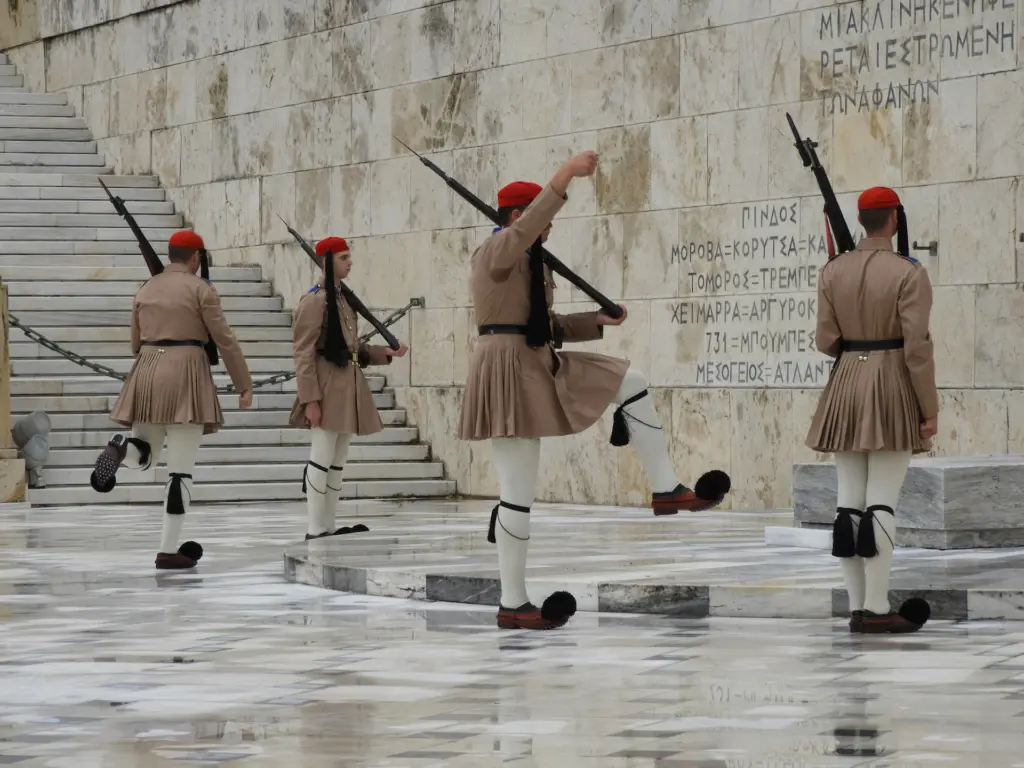
Changing of the Guard at the Tomb of the Unknown Soldier
This ceremony takes place every hour, on the hour, and is a solemn event that draws numerous spectators. If you’re curious, here’s an amazing video showcasing the Evzones’ Changing of the Guard Ceremony.
The ceremony lasts approximately 15 minutes, from 5 minutes before the hour to 10 minutes past the hour.
The Evzones then move in slow, synchronized motions, with every movement meticulously choreographed.
The ceremony begins with an Evzone coming from the barracks and replacing the one that’s been standing guard. A second Evzone serves as the overseer, ensuring that every step is executed with precision.
One of the most distinctive parts of the ceremony is the foot drill, where the Evzones raise their feet slowly and then strike the ground powerfully.
The relieving Evzone approaches, and both guards perform a sequence of synchronized movements before the relieved guard returns to the barracks.