Let’s talk about Filipino culture! When it comes to happiness and hospitality, Filipinos top the list! And it’s not just because of their sunny disposition – their culture plays a huge part too. From the tight-knit family bonds to the love of good food, karaoke, and fiestas, the Philippines is a country that knows how to have a good time!
Did you know that the Philippines is also the only predominantly Christian country in Asia? Yup, you read that right. The country’s history as a Spanish colony for over 300 years left a lasting impression on its culture and religion.
In this article, we’ll dive deeper into Filipino culture and explore how they shape the Filipino way of life. From key cultural concepts to customs and traditions, after reading this post, you’ll be all set for your trip to the Philippines!
Table of Contents
ToggleCultural Concepts in the Philippines
Pagmamano
Respect for the elders is an important aspect of Filipino culture and this is shown through the gesture of “Pagmamano.”
Pagmamano involves taking an elder’s hand and bringing it to one’s forehead as a sign of reverence. It’s a deeply ingrained cultural practice that is still observed in many parts of the Philippines, particularly in rural areas and among older generations.
The act of Pagmamano is a way of showing respect for one’s elders and acknowledging their wisdom and authority. By bringing an elder’s hand to one’s forehead, a person is showing that they are willing to receive the elder’s blessings. It’s a way of humbling oneself and acknowledging the elder’s wisdom and experience.

Bayanihan
The term “bayanihan” comes from the Tagalog word “bayan”, which means “community”, and “ihan”, which means “to move”.
In traditional Filipino culture, bayanihan refers to the practice of a community coming together to help a neighbor or family in need. The best example involves the whole community helping someone move their house to a new location (yes, the whole community will actually come to carry the house of their neighbor!)
Bayanihan is based on the belief that by working together and supporting each other, Filipinos can accomplish more than they could on their own.
Kapwa
Kapwa is a cultural concept in Filipino culture that refers to the interconnectedness and shared humanity of all people. I often heard Filipinos saying “Parehas naman tayong kapwa tao” which translates to “We are both the same human beings.”
The term “kapwa” comes from the Tagalog word “pwa”, which means “self.”
In essence, the concept of Kapwa emphasizes the idea that all people are interconnected and share a common identity. Kapwa is rooted in the belief that all people are equal and have inherent worth.
The Kapwa concept is emphasized further between Filipinos especially when they meet and recognize each other in a foreign country, they would use the term “Kabayan” which translates to “My fellow countrymate.” Filipinos often look out for each other especially abroad as a huge number of Filipinos find work outside the country, they’re known as OFWs (Overseas Filipino Workers).
Po and Opo
“Po” and “Opo” are unique honorifics found only in Filipino culture.
They are used to show politeness when speaking. You will no doubt hear this everywhere in the Philippines!
“Po” is a particle that is added to the end of a sentence or phrase to indicate respect. It’s similar to the English term “please”, and is used to make a request or express gratitude in a polite manner. You will sometimes even hear it in conjuction with English words such as “Yes po” and “Thank you po.”
For example, instead of saying “Gusto ko ng tubig” (I want water), a person might say “Gusto ko po ng tubig” (I would like some water, please).
“Opo” is a formal way of saying “yes.” For example, if an elder asks if a person wants some food, they might respond with “Opo” instead of the more casual “Oo”.
Bahala Na
A very interesting concept, “Bahala Na” is a common Filipino phrase that reflects the cultural value of optimism in the face of uncertainty.
The phrase can be translated to mean “Come what may” or “Leave it to fate.” It’s a value that encourages Filipinos to face life’s uncertainties with courage, and to trust that things will work out in the end.
At the same time, “Bahala Na” can also be seen as a form of fatalism, or the belief that events are predetermined and cannot be changed. It is somehow a double-edged sword that can be conveniently used under a variety of circumstances!
What is the Religion in Philippines?
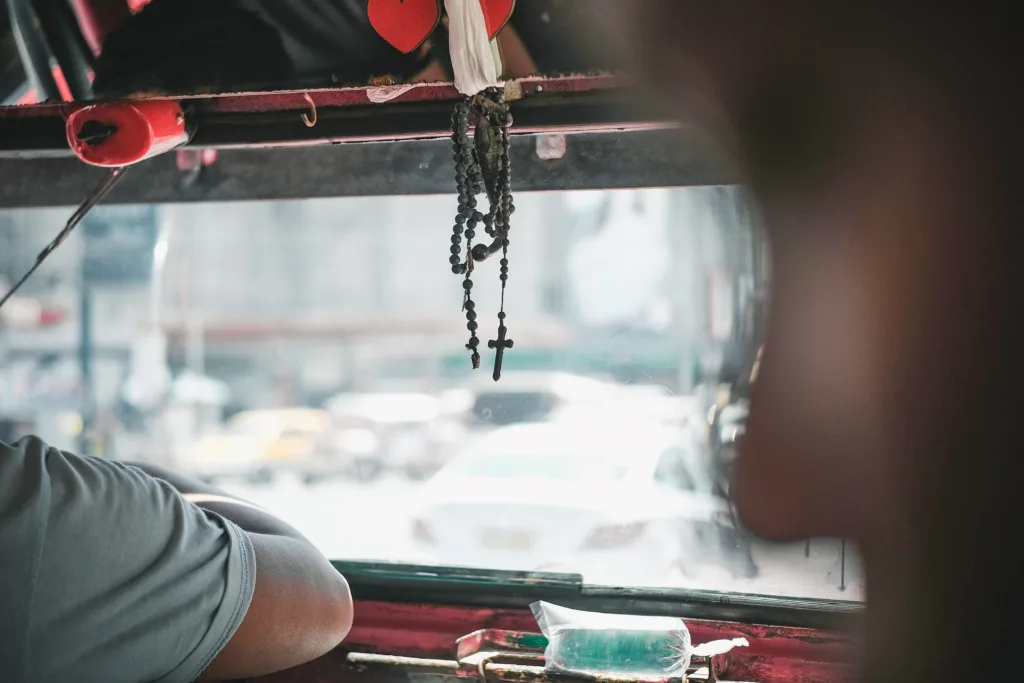
The Philippines is a predominantly Christian country, with approximately 86% of the population identifying as Roman Catholic. This is largely due to the country’s history as a Spanish colony for over three centuries, during which time Catholicism was introduced as is evidenced by the Magellan’s Cross in Cebu and San Augustin Church, the oldest church in the Philippines in the walled city of Intramuros.
Other religions represented in the Philippines include Islam (particularly in the southern region of Mindanao), Buddhism, and indigenous animistic beliefs in the northern regions of Luzon.
Religion plays an important role in Filipino culture with many religious festivals observed throughout the year. These include Christmas, Holy Week, and various other saints’ days and feast days that are celebrated with parades, processions, and other religious ceremonies.
Particularly interesting is the Black Nazarene, a statue of dark-skinned Jesus Christ carrying the cross that is venerated by millions of people in the Philippines.
What are the Traditions in the Philippines?
Shamanism
Shamanism is often associated with indigenous communities in the country, particularly those in rural areas.
Shamans, or babaylan as they are called in the Philippines, are believed to have the ability to communicate with spirits and to act as intermediaries between the physical and spiritual realms.
The role of the babaylan varies between different communities, but they are often responsible for performing healing rituals and ceremonies, as well as providing guidance to members of the community. Babaylans may use various techniques in their practices, including chanting, dancing, and the use of herbal remedies.
The Philippine government has also recognized the importance of shamanism as a cultural and spiritual tradition, and has taken steps to protect and promote the practice. In 1993, the Philippine Congress passed the Indigenous Peoples’ Rights Act, which recognizes the rights of indigenous communities to practice their traditional beliefs.
Belief in Enkanto
A bit similar to Disney’s Enkanto, “enkanto,” is a term used in Philippine folklore to refer to supernatural beings that are believed to inhabit certain natural places, such as mountains, forests, and bodies of water.
Some popular enkantos include duwende (dwarves), kapre (giant), tikbalang (a reverse-centaur), and the scary mananaggal, a creature that can remove it’s upper body and fly.
If you’re interested in Filipino folklore, I actually recommend checking out the Tales of Illumina, it’s an interactive museum in Manila. They have a decent exhibition of not only the creatures but also classic Filipino tales.
Belief in engkanto is common in many parts of the Philippines, particularly in rural areas.
According to legend, engkanto are powerful spirits that can be both benevolent and malevolent, depending on how they are treated. Many Filipinos believe that it is important to show respect to the engkanto in order to avoid their wrath. This may involve leaving offerings of food or other gifts at sacred sites, or avoiding certain areas altogether.
One way that I’ve seen it done is to say “Tabi tabi po” whenever you’re peeing out in nature. “Tabi tabi po” means excuse me and it’s usually addressed to the duwendes.

Albularyo
An albularyo is a traditional healer in the Philippines who specializes in herbal medicine and natural remedies. The term “albularyo” is derived from the Spanish word “herbolario,” which means herbalist.
Albularyos have been a part of Philippine society for centuries, and are often called upon to treat a wide range of ailments, from common illnesses to more serious conditions. They use a variety of natural remedies, including herbs, roots, and leaves, to treat their patients, and may also incorporate spiritual practices into their healing techniques.
The practice of albularyo is often passed down from generation to generation within communities. Many albularyos learn their craft through apprenticeships or through their family.
Simbang Gabi
Simbang Gabi is a nine-day novena of Masses that is traditionally celebrated in the days leading up to Christmas. The name “Simbang Gabi” means “night Mass,” and the novena is usually held in the early morning hours, starting as early as 4:00 AM.
Simbang Gabi is a beloved cultural tradition in the Philippines, and is considered an important part of the Christmas season. The novena is typically celebrated with great devotion, with many Filipinos waking up early to attend Mass.
Filipino Traditional Dance
One of the most well-known traditional dances in the Philippines is the Carinosa, which is considered the national dance of the country. Originating in the Visayan region, Carinosa is known for its graceful movements and flirtatious back-and-forth between the dancers. Often performed by a couple or a group of couples, Carinosa is a celebration of love and courtship.
Another popular folk dance in the Philippines is the Tinikling. The dance involves two bamboo poles that are clapped together rhythmically, while the dancers step in and out of the poles. You can often join this sort of dance during cultural shows if you find yourself in Bohol or Batangas. Just don’t get hit by the bamboo poles!
Pandanggo sa Ilaw involves balancing three oil lamps on the head and hands of the dancer, while performing graceful and fluid movements with the feet and body. It is a dance that is both challenging and beautiful.
A similar dance can also be found in Pangasinan called Binasuan. The Binasuan dance is typically performed by a male and a female dancer, each holding four glasses filled with rice wine or water. The dancers use their hands and feet to maneuver the glasses in intricate patterns, without spilling a single drop.
Filipino Traditional Music
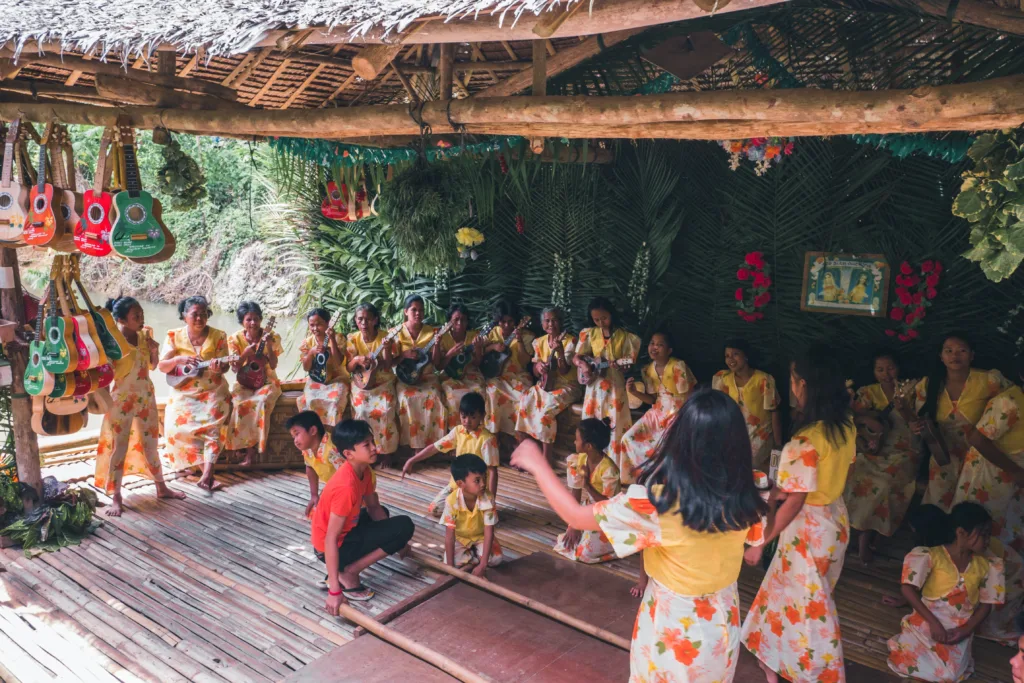
One of the most distinctive features of traditional Filipino music is the use of indigenous instruments, such as the kulintang, a set of small gongs that are played in an ensemble; the kudyapi, a stringed instrument similar to a lute; and the bamboo flute. Other instruments are the banduria (a type of mandolin) and the octavina (a small guitar).
There is also the cultural concept of Harana which I think fits quite well in this section. While not that common nowadays, Harana is a traditional Filipino form of courtship in which a man sings to a woman to express his love. The practice of harana dates back to the Spanish colonial period in the Philippines, when young men would serenade their loved ones at night, often accompanied by a guitar.
The harana tradition involves a group of young men who go to the home of the woman they wish to serenade. The men may sing several songs, often in a soft and romantic style, while the woman listens from their window.

What to Eat in the Philippines
Here are some popular dishes that showcase the delicious flavors of Filipino cuisine:
- Adobo: The national dish of the Philippines. Adobo features chicken or pork that has been marinated in vinegar, soy sauce, garlic, and other spices, then stewed until tender. The result is a savory and tangy dish that is often served with rice. If there’s one dish you have to try in the Philippines, this is it.
- Sinigang: A sour soup that is typically made with tamarind, along with tomatoes, onions, and meat or seafood. It packs a punch but tastes really good!
- Kare-kare: A flavorful stew that is typically made with beef, oxtail, or tripe, along with peanut butter and vegetables such as eggplant and string beans. You have to eat rice and bagoong (a fermented shrimp paste) with it!
- Pinakbet: A vegetable stew that features a variety of vegetables such as eggplant, okra, squash, and bitter melon that are cooked in a sauce made from shrimp paste, garlic, and onions.
- Bulalo: A hearty beef soup that is made with beef shanks and bone marrow, along with vegetables like corn, cabbage, and potatoes. You can find the best bulalo in Tagaytay‘s Balay Dako or in El Nido‘s Bulalo Plaza.
- Halo-halo: If you have a sweet tooth, try Halo-halo! It’s a popular Filipino dessert that features a mixture of shaved ice, milk, and a variety of sweet toppings, such as fruit, beans, and jellies.
- Balut: The infamous balut is a fertilized duck egg that is boiled and eaten whole, often served as a popular street food snack. The egg is typically eaten with a sprinkle of salt and vinegar, and it’s not for the faint of heart!
What is Filipino Language like?
While there is no such thing as “Filipino” language, the national language is Tagalog. Though there’s a myriad of dialects spoken across the entire archipelago.
As a Spanish colony, many Tagalog words have Spanish origins. Some examples of Spanish-derived Tagalog words include “silya” (chair) and “kalsada” (street).
There is also Taglish, similar to Singapore‘s Singlish, a form of code-switching that involves mixing Tagalog and English words and phrases in the same sentence or conversation. It is a common practice in the country, especially among younger generations. For example, you can simply mag- to English verbs while repeating the first syllable to denote that you will be doing the action, like “mag-jojogging” for “to go jogging” or “mag-swiswimming” for “to go swimming”.
Useful Tagalog Phrases for Travel
|
Tagalog
|
English
|
|---|---|
|
Kumusta ka?
|
How are you?
|
|
Salamat po
|
Thank you
|
|
Patawad po
|
I'm sorry
|
|
Magkano po iyan?
|
How much is it?
|
|
Saan po ang banyo?
|
Where is the restroom?
|
|
Marunong po kayo mag-Ingles?
|
Can you speak English?
|
|
Magandang umaga
|
Good morning
|
|
Magandang hapon
|
Good afternoon
|
|
Magandang gabi
|
Good night
|
|
Masarap
|
Delicious
|
Traditional Festivals in the Philippines
Ati-atihan Festival
The Ati-Atihan Festival is a colorful festival celebrated every year from January 8 to January 17 in the town of Kalibo, Aklan.
The festival dates back to the 13th century, when the Aetas, the indigenous people of Panay Island were said to have offered gifts to the Malay chief Marikudo in exchange for land. (We have met the Aetas before during our Mt. Pinatubo hike!)
The festival is celebrated every year from January 8 to January 17, with the main events taking place on the weekend closest to January 17. Participants, who are mostly dressed in traditional Ati costumes made of grass, bark, and leaves, paint their faces black in honor of the Aetas, who are believed to be the first settlers of the Philippines. They also carry wooden shields and spears, and dance to the beat of drums.

Sinulog Festival
Held annually on the third Sunday of January in Cebu. The festival honors the Sto. Niño (Child Jesus), the patron saint of Cebu with indigenous traditions as a form of religious syncretism.
The festival is a week-long celebration marked by street parties, colorful parades, and religious processions. The main highlight of the festival is the grand parade held on the third Sunday of January, which is participated in by various contingents from different parts of the country.
Participants, who are mostly clad in bright and colorful costumes, dance to music as they make their way through the streets of Cebu City.
The foot procession, which is held on the eve of the festival, involves a solemn and prayerful walk through the streets of Cebu City, with devotees carrying candles and images of the Sto. Niño.
Panagbenga Festival
The Panagbenga Festival is a month-long flower festival held in Baguio City, the summer capital of the Philippines. The festival is celebrated every February, and its name comes from the Kankanaey term “panagbenga,” which means “a season of blooming.”
The festival is known for its giant floats decorated with thousands of flowers, as well as performances by various cultural groups from all over the country.
Don’t miss the grand street parade, which happens on the fourth Sunday of February.
Customs in the Philippines
- Respect for elders is very important as shown by the “pagmamano” and “po and opo” cultural concepts
- Filipinos would at times use their hands to eat food, this is known as “kamayan.” It’s actually quite fun and it’s something we were able to do during our island hopping trip in El Nido.
- “Filipino time,” similar to “Mexican time” is a cultural trait is often associated with the laid-back nature of the Filipino culture, and it is not uncommon for Filipinos to arrive 15 minutes to an hour after the agreed-upon time.
- Tipping is not a common practice, but it is appreciated in some service industries, such as restaurants and hotels.
- Jeepneys have their own cultural eco-system and you are expected to help pass the money of other people to the driver and vice versa for the change.
- Dress modestly as the Philippines is a Christian country and can be a bit conservative
- This goes even more so for public displays of affection, keep it to a minimum
Plan Your Trip to the Philippines | Best Travel Resources
Book Your Accommodations
- Booking.com – the world’s leading online booking platform for accomodations around the world, they have an extensive amount of available listings with zero booking fees and best price guarantees.
- Hostelworld – a backpacker’s best friend, Hostelworld has the largest collection of hostels and guesthouses for affordable prices.
Don’t Forget Insurance
- SafetyWing – from Nomad Insurance, an insurance by nomads for nomads. They understand our lifestyle well and have really comprehensive and flexible plans that cater to any traveler.
Find Cheap Flights
- Kiwi.com – my go-to for booking and finding the cheapest flights and it’s helped me save tons of money. They do virtual interlining which is connecting flights from airlines that do not codeshare, so you can find routes that you wouldn’t be able to find normally.
Join Tours & Activities
- GetYourGuide – is one of the best places to find unique tours and activities. I found that it’s an excellent way to meet fellow travelers and create fond memories. They are not only limited to tours as they also offer niche services such as skip-the-line tickets or private transfers.
Catch a Ride
- Rentalcars.com – nothing beats the freedom of the road, Rentalcars.com is the world’s largest online car rental service. They operate across 160 countries so they’re the perfect partner to work with if you find yourself wanting a ride.