The Djed Pillar is often recognized as one of the most potent symbols in Egyptian mythology, denoting stability, resilience, and continuity.
A pillar-like glyph in Egyptian hieroglyphs, the Djed is frequently referred to as the “backbone of Osiris“, the god of the afterlife, the underworld, and rebirth. And was often referred to as the “lord of the Tree of Life.”
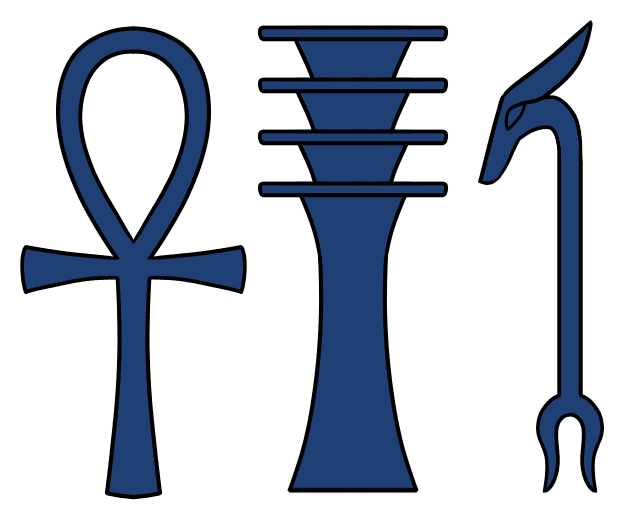
Its iconic shape, resembling a column with a broad base and capital, is topped by four parallel bars. This form is thought to represent a stylized human backbone or a tree trunk with its branches lopped off.
In Egyptian culture, the Djed Pillar is often interpreted as representing the enduring nature of the universe, the strength of the pharaoh, and the regenerative powers of Osiris.
Table of Contents
Toggle
Origin of the Djed Pillar
The story of the Djed Pillar is shrouded in the mists of antiquity. Initially connected to early agricultural practices, it’s believed that the Djed originally represented a sheaf of grain, embodying the idea of fertility and abundance. This would make sense in a society that was, above all, agrarian at its core.
As Egyptian civilization grew more complex, so too did the symbolism of the Djed. By the time of the Old Kingdom, the Djed was inextricably linked with the god Osiris. It was thought that just as the spine supports the body, the Djed supports the sustaining order of the universe.
Symbolism of the Djed Pillar
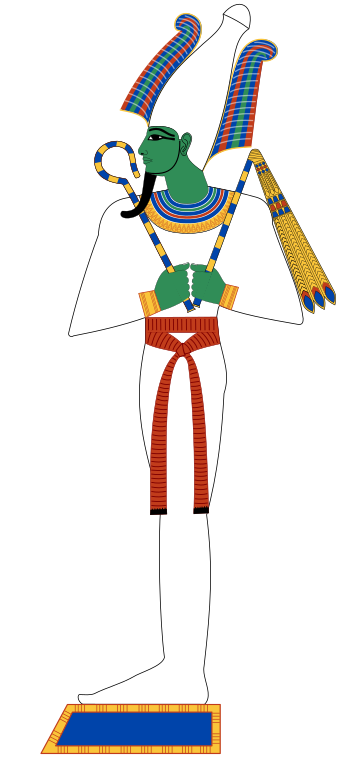
Most prominently, the Djed Pillar is known as the backbone of Osiris, embodying the god’s enduring spirit and his capacity to be reborn. Osiris, once a living king of Egypt according to myth, was murdered and dismembered by his brother Set.
His wife, Isis, reassembled his body and resurrected him, allowing him to become the ruler of the afterlife. In this context, the Djed Pillar not only alludes to Osiris’s spinal column but also metaphorically to the idea of rising again, as Osiris did from the dead.
The Djed thus becomes a symbol of stability that defies the chaos of death and disorder.
Further layers of symbolism include its association with fertility and the annual inundation of the Nile River, which brought life-giving silt and water to the fields of Egypt. As the Nile’s flood was the pulse that sustained Egyptian agriculture and, by extension, the entire civilization, the Djed was also a sign of enduring sustenance and the cyclical nature of life.
The Djed Pillar in Egyptian Mythology
The most significant mythical event involving the Djed is the “Raising of the Djed” ceremony. This was an annual festival in which the Djed Pillar was physically raised as a symbol of Osiris’s revival and the subsequent assurance of fertility, resurrection, and the continued harmony of the cosmos.
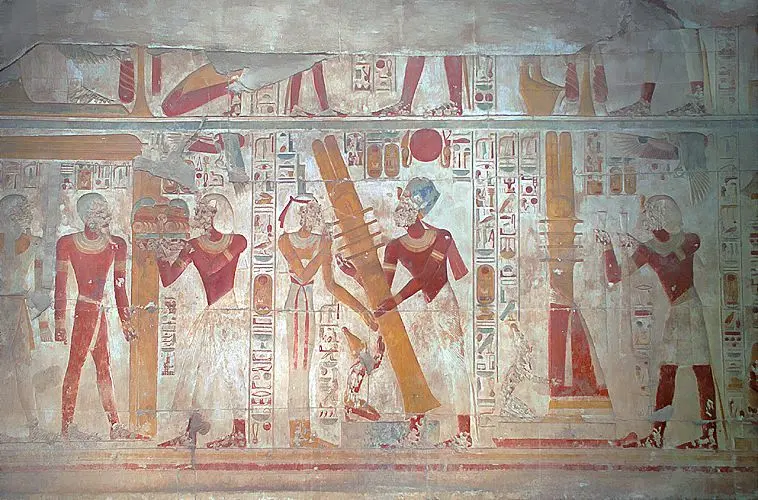
Artifacts and temple reliefs often depict this ceremony, showing the pharaoh, sometimes accompanied by priests, raising the Djed. This act was believed to reaffirm the religious order of the world, the triumph of life over death, and the pharaoh’s divine right to rule.
Beyond Osiris, other deities were also associated with the Djed, including Ptah, the god of creation and craftsmanship, who was sometimes depicted holding a staff that combined the Djed with the Ankh and the Was scepter, symbols of life and power respectively.
This amalgamation of symbols underscored the interconnectedness of these concepts within the Egyptian worldview: the life-giving power of the gods, the authority of the rulers, and the order of the universe itself.
The Djed Pillar and Pharaohs
Pharaohs were often depicted in a pose known as “Smiting the Enemy,” where they raised a weapon to strike down foes. In these depictions, the Djed pillar sometimes appears behind the pharaoh, reinforcing their might and divine support. It served as an assurance to the people that their ruler was strong, invincible, and sanctioned by the gods, particularly Osiris, to maintain order and fend off chaos.
The Djed also played a role during coronation ceremonies. The pharaoh, as the “living Horus,” was often associated with the concepts of resurrection and continuity, similar to Osiris. Thus, the Djed pillar, as a symbol of Osiris’s backbone, underlined the notion that the king was the backbone of Egyptian society, essential for its stability.
The association of the Djed with pharaonic power is well-documented in the archaeological record. One prominent example is a scene from the temple of Seti I in Abydos, which dates to the 19th Dynasty (1292-1189 BCE). In this scene, the king is depicted performing rituals involving the Djed pillar, affirming his role as the preserver of order.
The Djed Pillar in Daily Life
The Djed pillar, while a powerful religious and royal symbol, also found its way into the daily lives of the ancient Egyptians, indicating its broad significance and the Egyptians’ desire for stability in their personal lives.
The common people, wishing to emulate the divine protection and stability the Djed provided, incorporated it into various personal items. Amulets shaped like the Djed were worn for good luck and protection, believed to imbue the wearer with health and stability. These amulets have been found in various materials, including faience, a common material for everyday objects, indicating that they were not just reserved for the elite but were used by people of all social statuses.
Household items were sometimes adorned with the Djed pillar symbol as well. Pottery and domestic walls occasionally featured the Djed, likely serving as a household blessing for longevity and balance. Additionally, furniture and personal items such as cosmetic spoons and mirrors sometimes bore the Djed symbol, suggesting a cultural preference for invoking the sacred in the mundane aspects of life. You can find plenty of artifacts depicting the Djed in the Egyptian Museum in Cairo.
In the workman’s village of Deir el-Medina, home to the artisans who constructed the royal tombs in the Valley of the Kings, the Djed was a particularly popular amulet. The artisans here were literate and knowledgeable about religious texts and symbols, reflecting the broader Egyptian society’s understanding of the Djed’s significance.

The Djed Pillar and the Afterlife
One of the most compelling pieces of evidence for the Djed pillar’s funerary role comes from the “Opening of the Mouth” ceremony, a ritual that was believed to reanimate the deceased in the afterlife. The ceremony is depicted in many tombs, with priests often shown holding the Djed pillar to symbolize the restoration of the deceased’s power and mobility.
In the “Book of the Dead,” the Djed is frequently mentioned and depicted. The texts often illustrate the Djed alongside spells and incantations intended to protect and sustain the deceased in the afterlife. For instance, Spell 151 of the “Book of the Dead” is dedicated to the Djed, and it is specifically designed to secure the deceased’s backbone and grant them the power to stand and move in the netherworld, much like Osiris did after his resurrection.
The Djed Pillar in Hieroglyphics
Hieroglyphically, the Djed pillar represented a sound that scholars transcribe as “djed,” which could be used in words related to stability, endurance, and health. Its use was integral in the construction of phrases that conveyed the durability of the pharaoh’s reign, the stability of the state, or the health of an individual.
One particular example is the phrase “djed medu,” often translated as “enduring of speech,” which is a phrase commonly found inscribed in the context of the king’s decrees, meant to emphasize their perpetual and unalterable nature.