
In the grand theater of Egypt‘s sands there lies a story – or two.
Amidst the myriad of hieroglyphs and the Pyramids of Cairo, two ancient symbols take center stage.
Now, imagine two eyes, watching over time, one of Horus, the other of Ra. Superficially twins, yet each an enigma of its own.
Through the veils of time, these eyes have seen civilizations rise and fall, yet their own tales remain slightly blurred. Who were they really, and why do they matter?
The Eyes of Horus and Ra await, not just to be seen but to be known.
Hold tight; it’s time to dive deep into Egypt’s gaze.
Table of Contents
Toggle
Meet the Egyptian Deities
The ancient Egyptians’ pantheon is teeming with gods and goddesses. These divine beings were part of the very fabric of existence, influencing the Nile’s flow, the sun’s journey, and the fate of every soul.
At the heart of this pantheon, two figures cast particularly long shadows, their tales intertwined with the destiny of both mortals and gods: Horus and Ra.
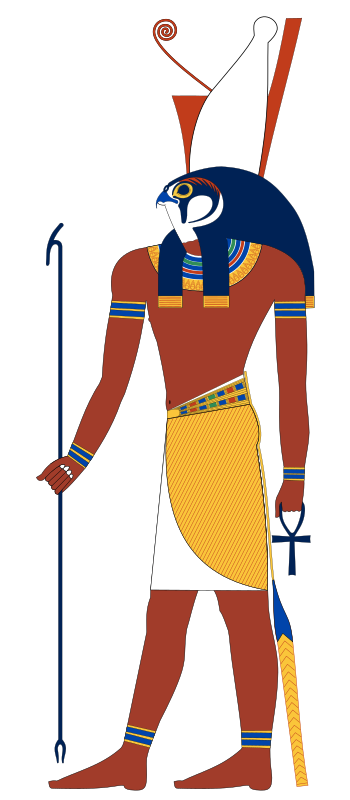
Horus, with the keen eyes of a falcon, is a deity of the sky, emblematic of power and kingship. Born of Osiris and Isis, his life was filled with challenges, most notably his epic battles against Set to avenge his father’s death and claim his rightful throne.
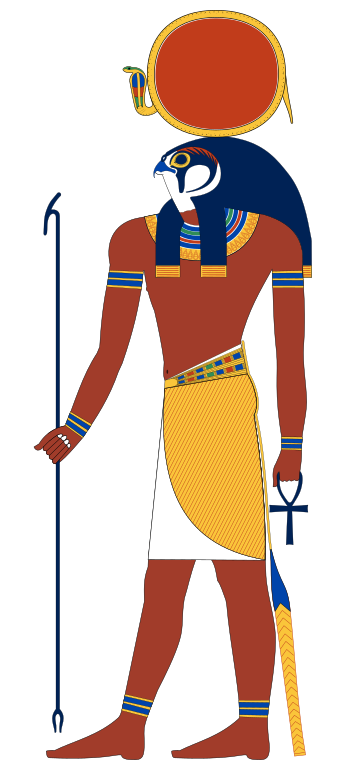
Ra, the radiant sun god, is often imagined as a falcon-headed being, with the sun disk crowning his head. Each day, he embarked on a journey, sailing across the sky, only to dive into the underworld by night, ensuring the cycle of day and night (this is further symbolized by the Scarab). To the Egyptians, Ra was more than a sun god; he was the life force and the promise of a new dawn.
The Eye of Horus
Origin
Whispered among the winds of the Sahara and etched into the walls of tombs and temples is the tale of Horus, the sky god, and his tumultuous quest for justice.
Once upon a timeless dusk in the realms of the gods, Osiris, the king of Egypt, was treacherously betrayed by his own brother, Set. In a plot of envy and ambition, Set murdered Osiris and claimed the throne. However, Osiris’ legacy was far from over, for he left behind a son, Horus, destined to challenge Set and reclaim what was rightfully his.
Young Horus, fueled by both the desire for revenge and the rightful claim to the throne, engaged in a series of fierce battles against Set. These confrontations, epic in their scale, raged not just on land but in the heavens, shaking the very foundations of the world. In one such ferocious encounter, Set gouged out Horus’s left eye, tearing it into pieces. The loss was more than just physical; the eye represented Horus’s perception, vitality, and power.
Yet, all was not lost. Thoth, the god of wisdom and magic, intervened, piecing together the fragmented eye, restoring its wholeness, albeit with scars. This mended eye become known as the “Udjat”.
The fight, however, was about more than just an eye. It was a battle of order against chaos, of rightful rule against treacherous ambition. In the end, Horus emerged victorious, banishing Set and reinstating ma’at – the divine order. With the throne regained, Horus became a beacon of hope, leadership, and resilience for all of Egypt.
Symbolism
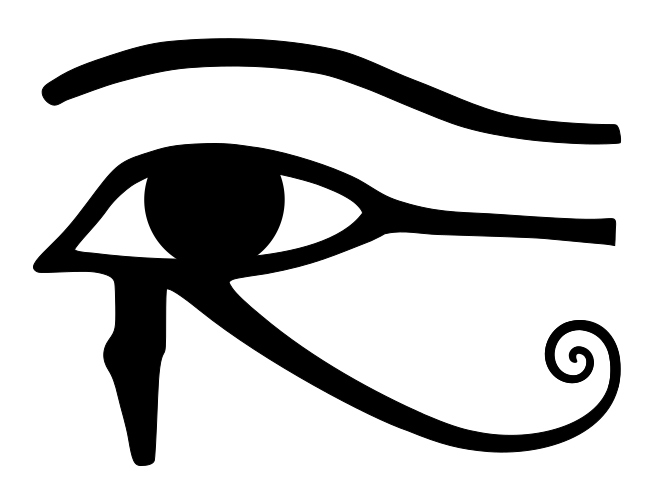
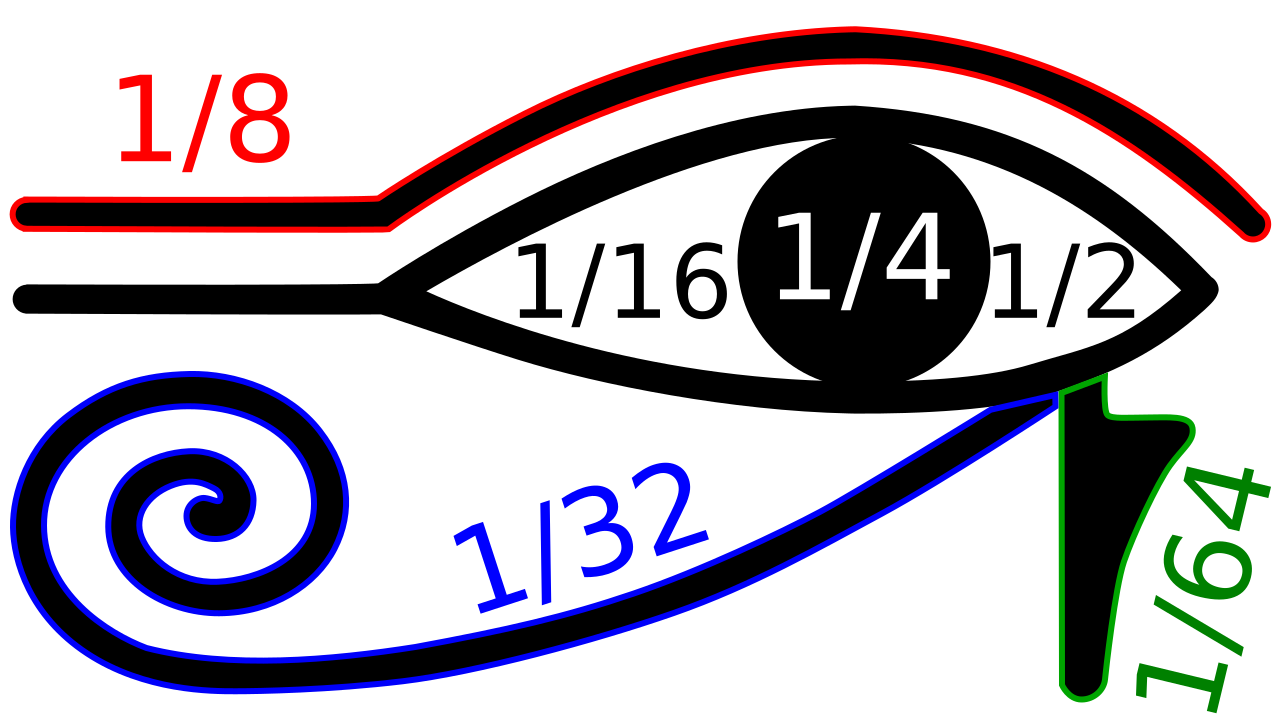
The Eye of Horus is also known as the “Left Eye”. At a glance, one can immediately identify it by its intricate structure, looking much like a stylized, almost falcon-like human eye. The pupil is centrally located, dark and intense. Just above the eye, a gracefully curved eyebrow extends. Extending outward from the corner of the eye, there’s a unique, extended curving line, often likened to a falcon’s beak, but also symbolically represents a stylized tear. Below the eye, a distinctive, spiral-shaped marking curls forward.
Here are some of its symbolisms:
Protection and Healing: Often used as an amulet, the Eye of Horus offers protection from evil forces, wards off ill intentions, and brings about healing. It’s a symbol people have turned to for safeguarding against harm. It’s quite similar to the Evil Eye amulet, wouldn’t you say?
Lunar Associations: The Eye of Horus is linked with the moon, resonating with themes of illumination in darkness, intuition, and inner wisdom.
Power: Worn by Pharaohs and depicted in royal insignia, the Eye represents royal authority and might. It stands as a testament to the Pharaoh’s divine right to rule and his role as a mediator between the gods and humanity.
Spiritual Perception: With its association to the moon and light, the Eye of Horus symbolizes insight, spiritual awakening, and the ability to perceive the unseen. It’s an emblem of inner vision.
Wholeness: As a symbol often broken down into various fractions (each representing a sense), when whole, the Eye epitomizes completeness.

Secrets
-
Mystical Fractions: The very design of the Eye of Horus is a riddle of mathematics. Broken down, each individual part of the Eye corresponds to a fraction. Starting from the front of the eye, and moving backward, the segments are attributed fractions as 1/2, 1/4, 1/8, 1/16, 1/32, and 1/64. This mathematical design resonates with the idea of wholeness, of being fragmented and then coming together again, much like the myth of Horus’s own eye.
-
Numerology: Touching on the realms of Sacred Geometry, the Eye’s fractional breakdown, leading to the number 63/64 (when all the fractions are added), is intriguing. The missing 1/64th is said to be the magic used by Thoth to restore the Eye. In numerology, the number 6 (6 parts of the Eye) is significant for its associations with balance, love, and nurturing. The number 3 (the primary fractions halve thrice) is linked to creativity, joy, and spiritual growth.
-
The Protective Coloration: Ancient Egyptians had a deep understanding of color symbolism. The Eye of Horus, often depicted in shades of blue, carries with it the qualities associated with this hue. Blue in ancient Egypt symbolized protection, good health, and rebirth. Think of the Blue Lotus for example.
-
Senses and Sensibilities: The individual parts of the Eye were also associated with the six senses (including thought as the sixth). The sense of sight was linked to the pupil, hearing to the spiral “teardrop,” thought to the eyebrow, smell to the curved tail, taste to the oblique bar, and touch to the straight vertical line.
-
Chakras and Energy: While primarily an Egyptian symbol, the Eye of Horus bears a striking resemblance to the Third Eye chakra in Eastern spiritual traditions (Hinduism and Buddhism). This chakra, located between the eyebrows, represents intuition, foresight, and spiritual enlightenment. The parallels between the two suggest a shared ancient understanding of energy and consciousness.
The Eye of Ra
Origin
The Eye of Ra, often regarded as the feminine counterpart to Ra himself, carries a legacy deeply enmeshed in the sun’s brilliance and fury.
As the ancient tales go, Ra, the Sun god, held dominion over the skies, gracing the earth with light and warmth. His eye, representative of the sun, became an emblem of his omnipotent gaze, watching over the lands of Egypt and ensuring order and prosperity.
This eye, however, wasn’t just a passive observer. It played active roles in myths, becoming an extension of Ra’s will and power. When angered, it manifested as a force of destruction, illuminating the duality of creation: the balance between life-giving and destruction.
One of the most enthralling tales associated with the Eye of Ra is its transformation into various goddesses. At times, the eye would become Hathor, the benevolent goddess of love, music, and dance. Yet, in moments of wrath, the same loving deity would transform into Sekhmet, the lion-headed goddess of war, bringing vengeance upon those who dared defy Ra. Bastet, the cat goddess symbolizing home and fertility, and Wadjet, the cobra goddess of lower Egypt, also represented facets of the Eye.
A particular legend speaks of the Eye’s departure from Egypt. In a fit of rage, the Eye, in the form of Hathor, distances herself from Ra, journeying to Nubia and morphing into the vengeful Sekhmet. The lands plunged into chaos without the Eye’s protective gaze. Realizing the gravity of the situation, Ra dispatched Thoth, the god of wisdom, to bring back the estranged Eye. Through persuasion and wisdom, Thoth managed to appease the Eye, leading to her return and the restoration of balance.
Symbolism
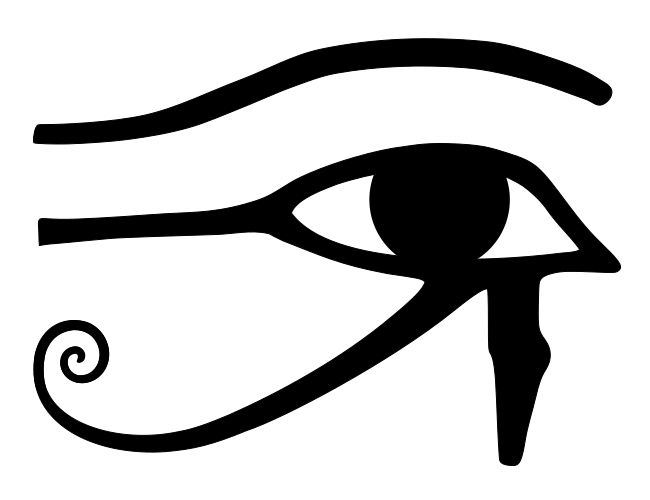
The Eye of Ra bears an undeniable resemblance to the Eye of Horus in its design, which has led to much confusion. Like the Eye of Horus, the Eye of Ra boasts a rich, dark pupil at its center and bear plenty of other similarities with its counterpart.
One of the most telling distinctions between the two is their association with different sides of the face. The Eye of Ra is traditionally considered the “Right Eye,” symbolizing the sun, whereas the Eye of Horus is the “Left Eye,” linked with the moon.
Here are more symbolisms:
-
Protection and Wrath: The Eye acts as a vigilant guardian, offering protection to those who revere it. But, it also encapsulates Ra’s fury, meting out punishment to foes and ensuring cosmic balance.
-
Divine Femininity: The Divine Feminine is often associated with goddesses like Hathor, Sekhmet, and Bastet, the Eye underscores the significance of feminine power in Egyptian mythology, emphasizing duality in its nurturing and destructive facets.
-
Healing and Restoration: The Eye is not just about wrath and protection. Ancient amulets bearing its image were believed to offer healing and rejuvenation, making it a symbol of renewal.
-
Cycle of Life: The stories surrounding the Eye, especially its departure and return, resonate with themes of discord and reconciliation, symbolizing life’s cyclical nature of challenges and resolutions.
-
Cosmic Order (Ma’at): In its role as an overseer, the Eye reinforces Ma’at, the ancient Egyptian concept of truth, balance, and order. It’s a constant reminder of the universe’s harmonious rhythm and the need to uphold it.
Secrets
Duality: The Eye’s ability to transform into various goddesses, each representing contrasting aspects (from love to wrath), hints at the ancient Egyptian understanding of duality in nature and the balance required to maintain order.
Numerology: The Eye of Ra was often depicted as being split into six parts, each representing a different sense. It also carryies the same fractional breakdown as its counterpart.
Alchemical Transmutations: Depicted in various colors, the Eye’s changing hues symbolized the varying stages of the alchemical process.
Hathor’s Tears: In some tales, the Eye of Ra, when in the form of Hathor, shed tears, and from them, humans were believed to be born.
Solar Eclipses: It was believed that the unpredictable nature of solar eclipses might have been interpreted as the Eye of Ra’s wrath or periods of her absence.
Sacred Geometry: Spirals are indicative of cycles, growth, and evolution. The Eye’s representation through this shape might hint at a more profound understanding of cosmic rhythms.
Eye of Horus vs Eye of Ra
In summary, here’s a table covering the key points to differentiate the two Eyes:
|
|
Eye of Horus
|
Eye of Ra
|
|---|---|---|
|
Origin
|
Derived from the legend where Horus's eye was gouged out by Set during their battle, only to be later restored by the deity Thoth.
|
Born from Ra's need to assert his power and authority, often manifesting as a force of protective wrath. Often associated with the tale where Ra sends his eye to seek Hathor, who had become the distant and wrathful goddess Sekhmet.
|
|
Symbolism
|
Represents healing, protection, and restoration. Signifies wholeness, especially with its intricate design and mathematical fractions.
|
Denotes protection but with a fierce and wrathful side. Represents Ra's power, authority, and radiant energy.
|
|
Associated Deities
|
Horus
|
Ra. Though, it's also personified through goddesses like Hathor, Sekhmet, Bastet, and Wadjet.
|
|
Usage
|
Frequently depicted on amulets, providing the wearer protection from harm. Used in various healing rituals and rites to ward off evil.
|
Emblematic in architecture and royal insignias to signify divine protection. Featured prominently in rituals asserting the pharaoh's divine might.
|
Astronomical Significance
The Ancient Egyptian calendar was primarily lunar-based, consisting of twelve months, each spanning 30 days, with an additional five intercalary days.
They also recognized the importance of both solar and lunar cycles, and their mythologies, in turn, reflected these celestial observances.
The moon’s phases, with its waxing and waning, align beautifully with the story of the Eye of Horus – the eye getting damaged and then restored. Each segment of the Wadjet, with its fractional representation, resonates with the various phases of the moon, from the crescent to the full moon. The lunar cycle’s completion, much like the restoration of the eye, symbolized wholeness and rebirth.
On the other hand, the Eye of Ra is closely tied to the solar cycle. Ra, the Sun God, was central to Egyptian cosmology. Each day, he embarked on his journey across the sky, ensuring the sustenance of life. The sun’s movement through the Zodiac over the year, its solstices, and equinoxes, were integral to the Egyptian understanding of time and cycles. The Eye of Ra, in this context, was seen as a fierce protective force, guarding Ra on his voyages, ensuring the cyclical nature of time.









3 Responses
This was an incredible read, Brandon!! I’ve read many articles about the Eye of Horus and Eye of Ra, and this one, without a doubt, has been the most comprehensive. I’d never been able to fully grasp the nature of the Eye of Ra in particular, but you explained it in a way that made sense. I learned so much about Egyptian lore and deities by reading this one article, and I can tell you put so much love and light into your work!! Keep it up! 🙂
Oh Savannah, your comment means the world to me! I’m so happy that the article was able to help you learn about the Eye of Ra. Thank you so much for your kind words!
Thank you! I gained some understanding. All the best to you. Hugh.