Have you ever noticed the symmetrical patterns of a snowflake, the precise spirals of a seashell, or perhaps the fractal shapes on a leaf? Everywhere in nature, we see patterns that seem to be just…perfect. That right there is Sacred Geometry.
Sacred Geometry seeks to understand and recognize the different patterns, shapes, and proportions that the universe ardently and consistently follows.
Call it the universe’s way of busting out some mathematical poetry through the corporeal world.
Since time immemorial, cultures across the globe have recognized these patterns, harnessing their power and embedding them into their architecture, mandalas, and spiritual practices.
But why? Why do these shapes and patterns evoke such a profound feeling of connection?
The answer lies in the intertwining of our physical realm with the spiritual, a dance between the tangible and the ethereal. And Sacred Geometry? Well, it serves as a spatial metaphor for the intricate relationships between the known and the mysterious, the finite and the infinite.
So, let’s dive in and uncover the layers that bridge our physical existence with the spiritual universe. Shall we?
Table of Contents
ToggleSacred Geometry Fundamentals
You’ve probably doodled them absentmindedly during a boring class, but have you ever stopped to think about the profound implications of basic geometrical shapes?
Sounds boring, I know and we’ll get to the juicy stuff later on.
But the beauty of Sacred Geometry lies in its simplicity. It’s the fundamental shapes, the building blocks of our universe, that whisper the loudest tales of the cosmos, spirituality, and our own intrinsic nature.
- Circles: The circle, an endless loop with no beginning or end, is perhaps the most profound and spiritual of all shapes. It represents unity, wholeness, and infinity. Think of the cycles of life, the planets in our solar system, and even the pupils of our eyes. The circle embodies a sense of oneness and completeness, often symbolizing the soul that is eternal.
- Squares: Representing stability and grounding, squares are symbolic of the earthly realm. Each of its four sides speaks to the cardinal directions, the four elements, and even the phases of life. In many cultures, the square signifies the material world, a solid foundation on which life is built. It is the shape of boundaries but also the comfort of structure.
- Triangles: Triangles are the bridge between the divine and the mundane. Pointing upwards, they symbolize male energy (Shiva), the sky, and ascension. Reversed, they echo feminine energy (Shakti), the womb, and the chthonic underworld. This nature of the triangle makes it a representation of balance and duality. Whether it’s the Holy Trinity in Christianity, the Sri Yantra in Hinduism, or the Trikaya in Buddhism, the triangle has always played a role in connecting the spiritual with the physical.
- Spirals: A shape that depicts evolution, growth, and cosmic energy, the spiral is the Sacred Geometry’s answer to life’s rhythm. Be it the spirals of galaxies, the twist of DNA, or the growth pattern of shells, spirals are nature’s way of showcasing the eternal process of growth, transformation, and evolution. It’s a symbol that everything in life is in a constant state of change yet is still connected to its origin.
Vesica Piscis
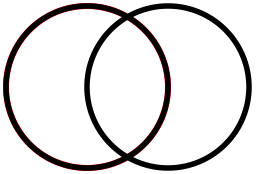
Now, we will be going on a journey. Evolving from the circle, now we have 2 circles! You may recognize it as the Venn Diagram but in Sacred Geometry, it is known as the Vesica Piscis. This simple yet profound shape sets the stage for much of the geometry that follows, and understanding its significance will equip us with a foundational knowledge to appreciate the complexities of subsequent patterns.
- Definition: The Vesica Piscis is created when two equal circles overlap, and their centers lie on each other’s periphery. The almond-shaped region where the circles intersect is the Vesica Piscis. If you’ve ever observed the patterns sunlight casts through windows in the morning or the shape your coffee cup makes when reflected in a glass surface, you’ve glimpsed the Vesica Piscis. It’s a pattern prevalent in nature, and once you know of its existence, you begin to spot it everywhere.
- Symbolism: Throughout history, the Vesica Piscis has been a symbol of the union of opposites; it can represent light and dark, male and female, or heaven and earth. This duality encapsulates the essence of existence and the balance that permeates every aspect of life. The Vesica Piscis is often viewed as a symbol of creation and a representation of the divine feminine, sometimes referred to as the “womb of the universe.” The Christian tradition, for instance, often uses this symbol as a halo around Christ. Its shape is also reminiscent of the Ichthys or “Jesus fish” symbol popular in Christian iconography.

Seed of Life
While the Vesica Piscis introduced us to the harmonious union of duality, the Seed of Life expands upon this notion, bringing forth the concept of creation and the interconnectedness of existence.
- Definition:The Seed of Life is comprised of seven overlapping circles of equal size. Picture a flower with six petals, and at its center, a seventh circle: that’s the Seed of Life. It begins with the Vesica Piscis (the central circle and one of the petal circles) and is constructed by drawing more circles with a compass, each originating from the vesica’s intersections.
- Symbolism: The Seed of Life, with its seven circles, is often associated with creation myths worldwide. The seven-day creation story found in the Abrahamic traditions resonates with this symbol. Each circle can be thought of as a day, and together they represent the fullness of creation.

Egg of Life
The Egg of Life, a symbol that resonates deeply with the very foundation of all organic structures.
- Definition:The Egg of Life is essentially the next step in the progression from the Seed of Life. It consists of eight spheres, all of equal size and touch one another at their edges. If you imagine the Seed of Life in 3D, the Egg of Life is what you’d get. The Egg of Life is like a cluster of cells, and, in fact, it mirrors the shape and arrangement of the first eight cells of a fertilized egg in embryonic development!
- Symbolism: The Egg of Life is considered a symbol of fertility, creation, and the growth processes of life. Due to its resemblance to the embryonic cell cluster, it’s often referred to as the blueprint of life itself. Every living organism’s cellular arrangement begins with this shape, making it a foundational emblem in sacred geometry. Its configuration is also similar to the patterns energy flows make in nature, and some esoteric teachings suggest that our own chakras are aligned in a manner reminiscent of the Egg of Life.
Flower of Life
The Flower of Life is often hailed as the “blueprint of the universe”.
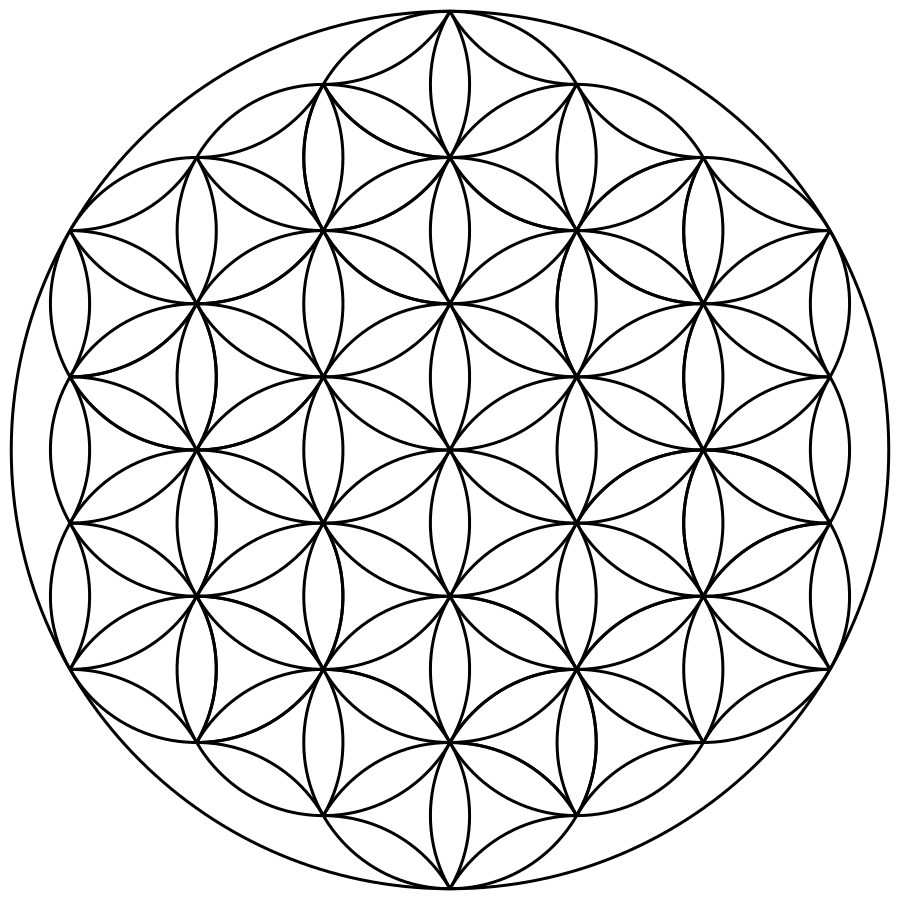
- Definition: The Flower of Life is a dazzling pattern of 19 interlocked circles, all encapsulated within a larger boundary circle. What starts as the Seed of Life evolves, with each circle being drawn from the intersection of two other circles, creating a symphony of interlaced loops.
- Symbolism: What makes the Flower of Life exceptionally intriguing is its encapsulation of critical geometric figures. Hidden within its intricate mesh are shapes like the Fruit of Life, Metatron’s Cube, and even the 3D forms known as the Platonic Solids. The intricate patterns found within the Flower of Life have been said to represent the blueprint of the universe, capturing the spatial relationships and proportions of the cosmos.
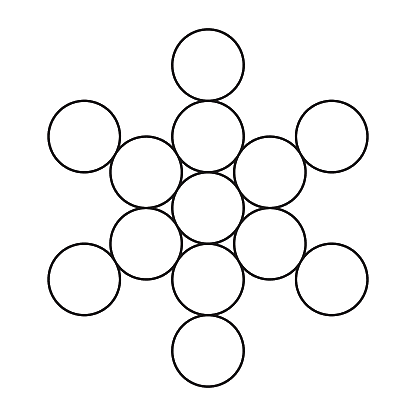
Fruit of Life
Meditating upon the Fruit of Life (or any sacred pattern), one might grasp the infinite possibilities that lie in the realms beyond our perception, recognizing that our reality is just one of countless others waiting to be explored.
- Definition: The Fruit of Life is a component of the Flower of Life, constituted by thirteen circles. If you envision the Flower of Life, the Fruit is formed when the center circle is surrounded by two concentric rings of circles. This geometric structure is seen as the “hidden pattern” within the Flower of Life.
- Symbolism: The Fruit of Life is often cited as hinting at multi-dimensional realms. Its thirteen circles are seen by some as gateways to these dimensions. Each of the thirteen circles is also said to represent an “information system” of sorts that unravels the mysteries of the universe.
Platonic Solids
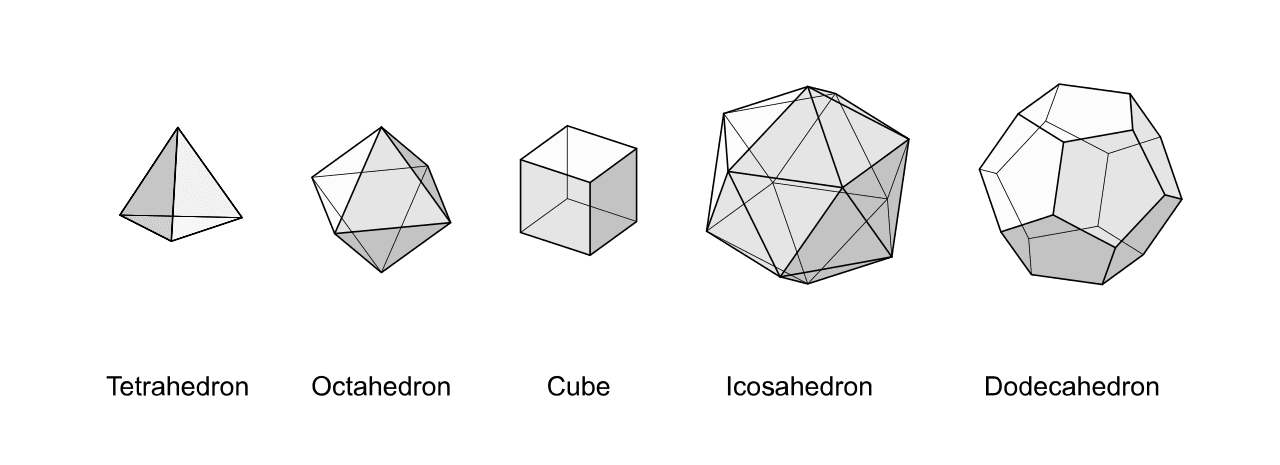
How about something less circular? Meet the Platonic Solids — five unique three-dimensional shapes that are fundamental to our universe’s structure. From Ancient Greece, where the philosopher Plato lent his name to these shapes.
- Definition: The Platonic Solids are five polyhedra that are unique in having all their faces, angles, and edges congruent. The Platonic Solids epitomize balance and perfection due to their congruence in every dimension. They are representative of the purest forms of transformation, given that each can fit perfectly within a sphere, with every point touching the sphere’s inner surface.These five are:
-
- Tetrahedron: A pyramid with four equilateral triangle faces.
- Hexahedron (Cube): Six square faces.
- Octahedron: Comprises eight equilateral triangles.
- Dodecahedron: Twelve pentagonal faces.
- Icosahedron: Made up of twenty equilateral triangles.
- Symbolism: Each solid is often related to one of the classical elements — earth (cube), air (octahedron), fire (tetrahedron), water (icosahedron), and the universe or ether (dodecahedron). This set of five elements is further found in Ayurvedic traditions and even represented by the Pandava brothers in the Sanskrit epic, Mahabharata. They signify the foundational forces of creation. Just as DNA is seen as the building block of life, Platonic Solids are the building blocks in the realm of sacred geometry, underlying the structure of everything in existence.
Tree of Life
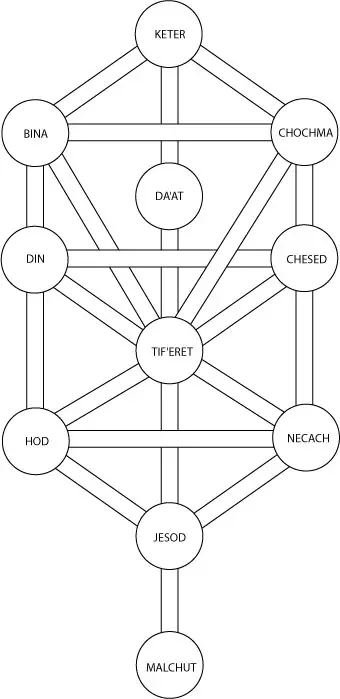
Now, we find ourselves standing before the magnificent Tree of Life. Not to be mistaken with its religious counterparts, this Tree is a Kabbalistic emblem that diagrams the universe’s structure and one’s own spiritual journey. Though rooted deeply in the Kabbalah, similar concepts of the Tree of Life appear across various cultures. Whether it’s the Yggdrasil from Norse mythology or the World Tree from various indigenous traditions, the idea of a cosmic tree connecting different realms is a nearly universal theme.
- Definition: The Tree of Life, or “Etz Chaim” in Hebrew, is an esoteric symbol rooted in the ancient Jewish mystical system known as the Kabbalah. It is visualized as ten spheres or “sefirot,” interconnected by 22 paths. These spheres represent emanations through which the Infinite Source reveals itself and continuously creates the universe.
- Symbolism: The Tree is believed to be a blueprint of creation, capturing the different stages and energies through which the universe has come into being and is maintained. Each sefira corresponds to a particular aspect of reality, but when looked at from a human perspective, they mirror the journey of the soul and can be related to psychological states. The Tree of Life signifies the universe’s vastness (macrocosm) and the individual’s spiritual journey (microcosm). This dual nature highlights the interconnectedness of the grand universe and the individual soul.
Metatron's Cube
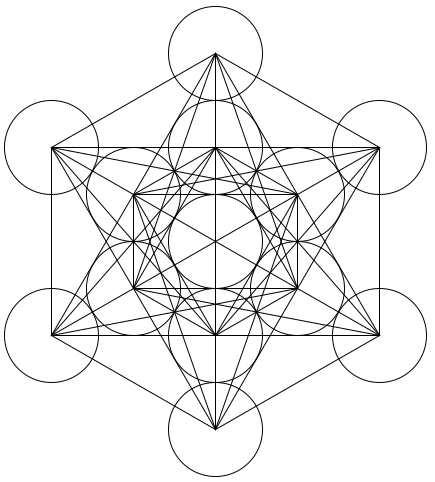
The awe-inspiring Metatron’s Cube, a figure intricately woven with multi-dimensional significance and cosmic resonance. Similar to the Tree of Life, the Metatron’s Cube finds its roots in ancient Jewish mystical texts, though it has also been embraced by various spiritual and modern metaphysical circles.
- Definition: Metatron’s Cube is a complex geometric figure made up of 13 circles with lines extending from the center of each. These lines interlock to create a grid, and within this grid, almost all the shapes we have covered can be found, including the Tree of Life and all five Platonic Solids. It’s named after Archangel Metatron, who is said to watch over the flow of energy that connects the divine and the earthly, acting as a bridge between the Creator and humanity.
- Symbolism: As linked to Archangel Metatron, this cube symbolizes his role in overseeing and connecting the vast web of energy, including the patterns that make up physical reality and the unseen energetic undercurrents. Despite the seemingly different geometric patterns, they all emerge from one foundational shape, suggesting that at the core, all life and existence are unified.