The Vesica Piscis, characterized by the intriguing overlap of two circles of identical radius, stands as a profound symbol that has spanned cultures, continents, and millennia.
You can find its presence in the heartland of ancient Mesopotamia to the symbolic scripts of Egyptian hieroglyphs, the Vesica’s essence seems universally resonant, pointing at an inherent, perhaps intuitive, human attraction to its form and what it represents.
Venturing beyond its historical bearings, the Vesica Piscis becomes even more enthralling within the framework of Sacred Geometry.
A foundational construct, intricately linked with patterns that speak of existence, divinity, and the universe itself.
Table of Contents
Toggle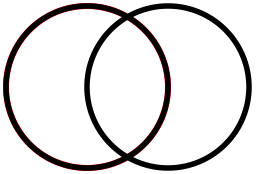
What is the Vesica Piscis?
The Vesica Piscis, often simply termed as “the Vesica,” is a shape formed by the intersection of two circles with the same radius, where the center of each circle is on the circumference of the other.
Visually, it resembles a fish’s bladder, which is what the term “Vesica Piscis” translates to from Latin.
Within the realm of Sacred Geometry, the shape itself is seen as a representation of profound unity and its elongated central shape is also seen as a powerful symbol of the Divine Feminine.
Origin of the Vesica Piscis
It’s believed that even before people understood its profound geometric and spiritual implications, the shape had a certain intuitive appeal. This intuition might have stemmed from natural occurrences of the Vesica shape, such as in the overlapping of bubbles or in certain visual phenomena related to the sun and moon.
The Vesica Piscis was already quite present even in ancient civilizations.
Ancient Mesopotamia: One of the earliest appearances of the Vesica Piscis can be traced back to Mesopotamia, the cradle of civilization. Ancient amulets bearing the Vesica shape have been excavated from archaeological sites in this region.
-
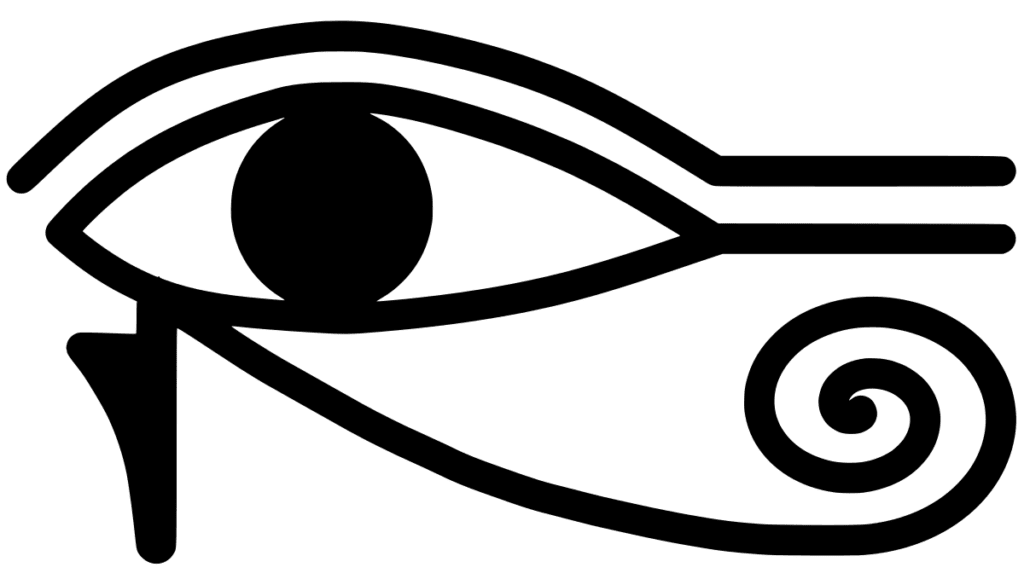
Ancient Egypt: The ancient Egyptians, renowned for their profound knowledge in geometry and spirituality, have hieroglyphs and symbols that bear a striking resemblance to the Vesica Piscis. This symbol is often linked with the Eye of Horus.
-
Prehistoric Europe: In several prehistoric caves across Europe, especially those dating back to the Neolithic age, there are rock paintings and carvings that showcase circles overlapping, hinting at the rudimentary depictions of the Vesica Piscis.
-
Minoan Crete: In the ancient Minoan civilization, which thrived on the island of Crete, there are frescoes and pottery designs that integrate the Vesica Piscis.
The Vesica Piscis and Sacred Geometry
What is Sacred Geometry?
Sacred Geometry seeks to understand and decipher the divine patterns that have been integral to spiritual sites and symbols throughout history.
It’s a study, or perhaps more aptly, a celebration of the universal designs that serve as the foundational structures of our reality.
Take a look at the spirals of the hurricanes or the hexagonal cells of a honeycomb, nature continually expresses itself through these unique patterns.
In spiritual traditions, these patterns aren’t just seen as random designs but as manifestations of the divine.
They are symbols that bridge the mortal realm with that of the divine, serving as the foundational “blueprint” upon which the universe is structured.

The Geometry Behind the Vesica Piscis
To reiterate, the Vesica Piscis is a symbol created by overlapping two circles of the same diameter, with the center of each circle resting on the circumference of the other.
This overlap generates an almond-shaped middle section, known as a mandorla.
Mathematically speaking, the ratio of the height of this mandorla to the width across its middle is the square root of 3.
In Sacred Geometry, the Vesica Piscis is seen as the womb of the universe, a gateway to higher realms.
It’s a reflection of the first act of creation, where unity (the first circle) differentiates into duality (the second circle), birthing existence as we know it.
The overlapping region between these two circles can be seen as a “common ground” between two distinct realms.
The Vesica Piscis and Other Symbols
The Vesica Piscis is a cornerstone of Sacred Geometry, serving as the womb from which other shapes are birthed. It’s not just a symbol; it’s a generator of form and a connector of principles. Here’s how it intertwines with other sacred geometrical constructs:
-
Seed of Life: Starting with a single circle (representing unity or the Source) and drawing a second circle with its center on the first circle’s perimeter creates the Vesica Piscis. Continuing this process by adding additional circles, each centered on the perimeter of the original, results in the Seed of Life—a pattern of seven overlapping circles.
-
Flower of Life: Extend this pattern further, and the Flower of Life emerges—a network of interlocking circles and Vesica Piscis shapes. The Flower of Life is often considered the blueprint of creation, containing the patterns of life and consciousness. Within the Flower of Life, you can find other significant shapes such as the Fruit of Life and the Egg of Life.

Metatron’s Cube: Continuing from the Flower of Life, if specific circles are connected with straight lines, Metatron’s Cube emerges. This shape contains all five Platonic Solids—the building blocks of matter. The Vesica Piscis, therefore, indirectly aids in deriving the very shapes that are foundational to physical reality.
The Tree of Life: In Kabbalistic teachings, the Tree of Life, a diagram of ten spheres (or Sephirot) and 22 paths, is used to understand the nature of God and the universe. Its design can be overlaid upon the Flower of Life and can be derived from principles of the Vesica Piscis.
Double Torus: The Vesica Piscis can also be visualized in three dimensions, where it becomes a lens-like shape between two toroidal (donut-like) fields. This configuration, known as the double torus, is found in various scales of existence, from galaxies to the human heart’s electromagnetic field.
Vesica Piscis Symbolism
Birth and Creation
The Vesica Piscis, with its distinct almond-shaped design, seems to encapsulate the emergence of life to the sacred process of creation itself.
Much like a womb nurtures and eventually brings forth life, the Vesica Piscis symbolizes the cosmic origin from which all of existence emerges.
As the Womb of the Univere, it represents that primordial space from which the universe sprung forth, hinting at both a beginning and a cyclical continuation.
In Sacred Geometry, the Vesica Piscis symbolizes the foundational energy pattern from which all other shapes in sacred geometry can be derived.
Hence, it is also dubbed the Womb of Geometry, the starting point, the doorway to deeper and more complex forms and patterns.
The Cosmic Egg
In Hindu mythology, the concept of creation is often depicted with a golden cosmic egg, known as the “Hiranyagarbha”.
This golden womb floats in the void of nothingness until it splits asunder to form heaven and earth.
The imagery of this split, of one becoming two, echoes the formation of the Vesica Piscis, where the merging of two circles creates a new central space.
The concept of the Cosmic Egg is also found in other cultures such as Ancient Greek and Egyptian as well as Chinese mythology.
Duality and Unity
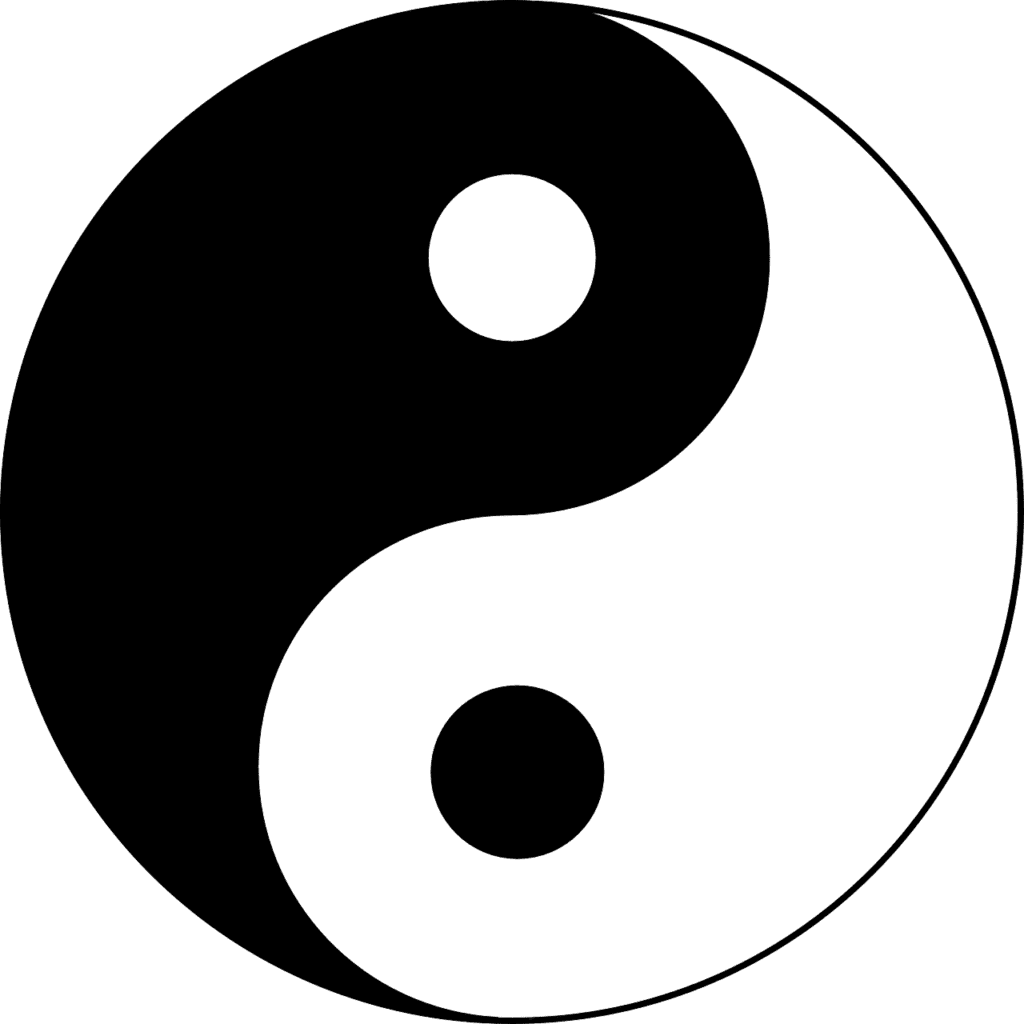
Duality implies the existence of two fundamental principles or components. In the world around us, this might manifest as day and night, male and female, or light and shadow. The twin circles of the Vesica Piscis echo this very notion, each one distinct and separate yet intrinsically linked to the other.
It’s the balance of yin and yang in Taoism, the dance between Shiva and Shakti in Hinduism. These dualities are not seen as conflicting but rather as elements that, together, bring about completeness.
The space where these two circles of the Vesica Piscis overlap, however, symbolizes unity.
In the end, while dualities exist, there is an underlying oneness that transcends them. This union, or the Vesica Piscis itself, represents that unity of all things and the idea that all dualities merge into a singular source.
Again, let me draw parallels to the concept Brahman of Hinduism, the Tao of Taoism, and even in Reiki it’s known as the Source.
A Portal Between Realms
Upon observing the Vesica Piscis, one witnesses the overlap of two spheres.
It’s neither entirely of one sphere nor of the other but exists in between, occupying a shared space.
More than just a simple Venn Diagram, this “in-betweenness” is what gives the Vesica Piscis its unique significance as a portal.
Just as twilight is neither wholly day nor wholly night, the Vesica Piscis stands between two realms, providing a bridge or doorway from one state of being to another.
Whether it’s the journey of the soul from the mortal realm to the divine, or the shaman’s journey from the physical world to the spirit world, the idea is of transcending the known to access the unknown.
Divine Feminine
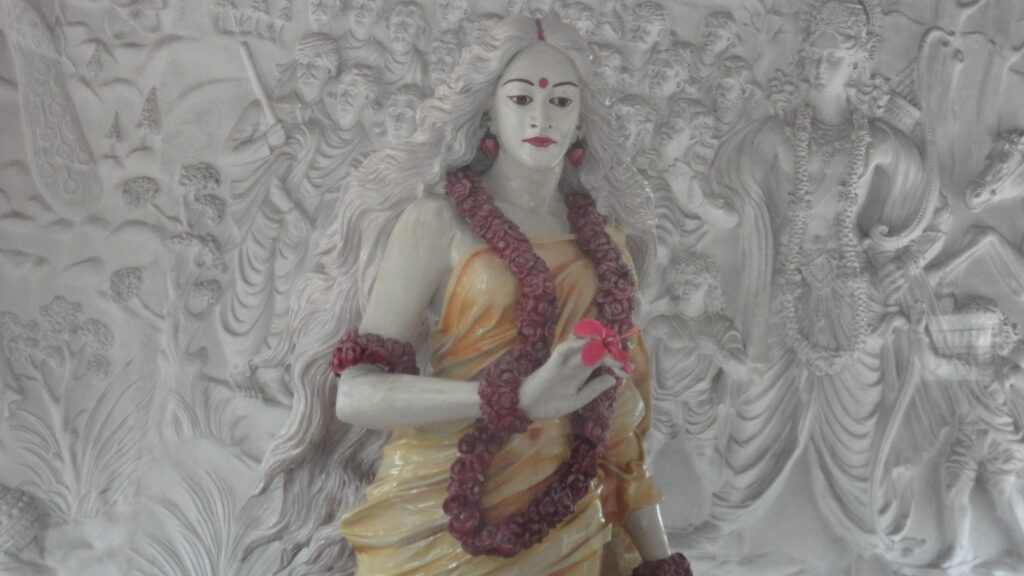
The concept of the Divine Feminine is as ancient as humanity itself.
Across cultures,there has always been an innate recognition of the primordial feminine energy that gives birth to all of creation.
The shape itself, formed by the overlap of two circles, is reminiscent of the female anatomy, symbolizing the gateway through which life emerges.
This is not merely a physical allusion; it is also a metaphorical nod to the idea that the feminine principle is the source of all creation, encompassing the mysteries of birth, rebirth, and the cyclical nature of life.

The Vesica Piscis and Christian Iconography
The very name “Vesica Piscis” translates to “bladder of the fish,” and the shape itself bears a striking resemblance to a fish, a powerful symbol in early Christianity.
-
The Ichthys: One of the most recognized symbols of early Christianity is the Ichthys, or fish symbol. Believers used it as a secret sign during the times when Christians faced persecution. The fish’s outline is a simple representation of the Vesica Piscis and the name “Ichthys” is an acronym in Greek for “Jesus Christ, Son of God, Savior.”
-
Virgin Mary: The Vesica Piscis also frames many depictions of the Virgin Mary in medieval and Renaissance art. Its shape is seen as the womb from which Jesus, the light of the world, came forth. Thus, Mary’s association with the Vesica Piscis not only emphasizes her role as the mother of Christ but also her position as the Theotokos or “God-bearer.”
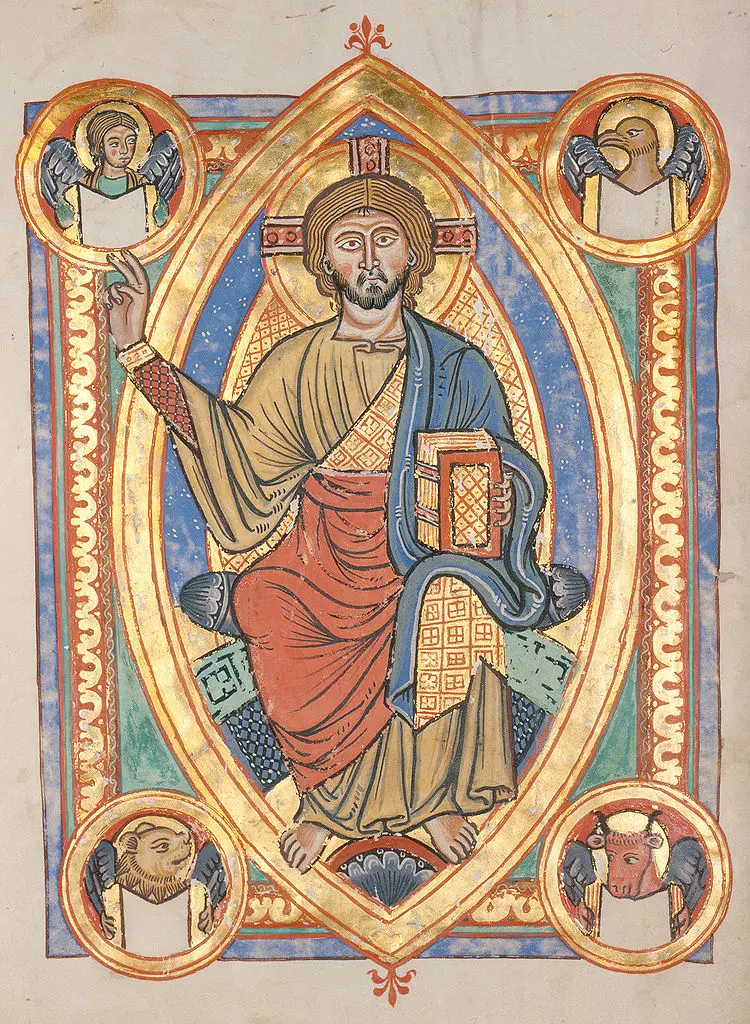
Christ and The Mandorla: One of the most profound uses of the Vesica Piscis in Christian art is the Mandorla, an almond-shaped aureole that surrounds depictions of Christ and other holy figures. In many iconic representations, Christ is depicted emerging from or being surrounded by this shape, especially during significant events like the Transfiguration, the Resurrection, or the Last Judgment. The Mandorla serves as a window between the earthly and the divine, indicating the moments when the human and the celestial realms intersect.
Duality and Unity: The overlapping nature of the Vesica Piscis can also be interpreted as the union of heaven and earth and in this context, it serves as a visual representation of the dual nature of Christ, being both divine and human.
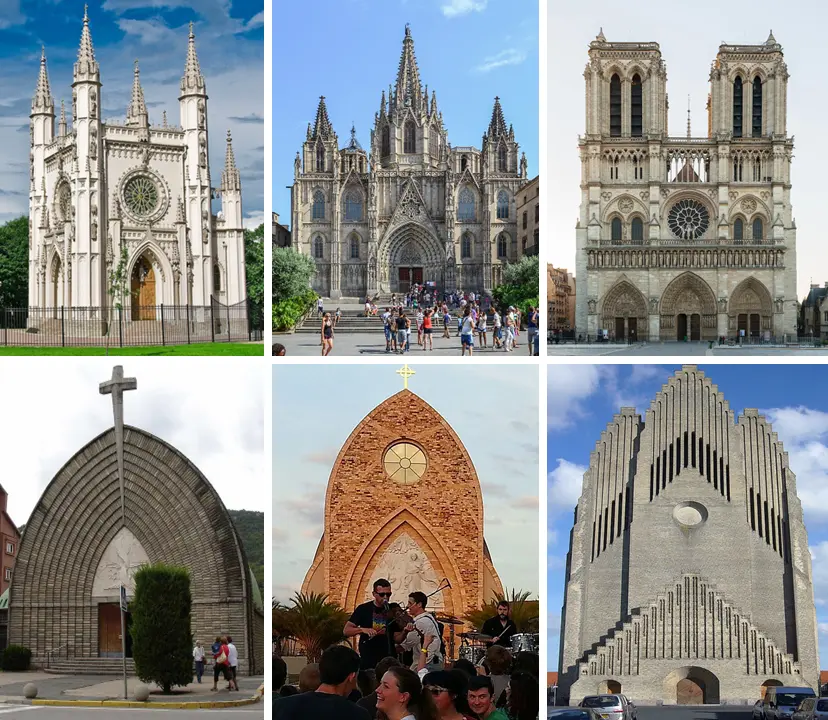
Church Architecture: The influence of the Vesica Piscis extends to Christian architecture. The shape has been used in the design of Gothic arches and stained glass windows. It’s not uncommon to find the Vesica Piscis shape adorning cathedrals, emphasizing places of significant spiritual importance.