first night in nepal
From Bangladesh to Nepal, I found myself in the capital city of Kathmandu. A far cry from Dhaka, and a welcome one at that. Lisa, my travel buddy whom I met in Niigata, arrived earlier in the day. This time around, I wasn’t traveling solo.
I got lost in the immigration, and couldn’t really figure out if I got all the requirements right until I was in front of the counter. Turns out, I didn’t and had to go way back in line which was now quadruple the length and twice as crowded. I realized I was tired and definitely didn’t have the energy to go out for dinner anymore which I told Lisa.
I met up with Coco back at the line so at least it wasn’t all too bad. Coco was a Chinese friend that I made over in Dhaka’s airport. We chatted while waiting with what broken Chinese I could muster. I got on the prepaid taxi and off we went to Elbrus Home, our hostel for the next few days in Kathmandu.
morning calm in boudanath
Waking up to a morning in Nepal was something else, the chilly air seeping through our tiny room, yet it was still cozy with picture frames of the Buddha Eyes and Ganesha hanging on the walls.
Lisa wasn’t a morning person so I jokingly urged her with a “Let’s go?” just as she showed signs of waking. And off we went downstairs to get our breakfast: omelet, toast, honey, mango juice, and milk tea. A hearty meal. I was reading a pamphlet on the Boudanath Stupa that I found tucked away on the lounge’s book stands. This was where we were going first. A guy in Elbrus Home called us a taxi and off we went.
I found myself comparing the streets of Kathmandu to Dhaka, it was much cleaner here. That’s for sure.
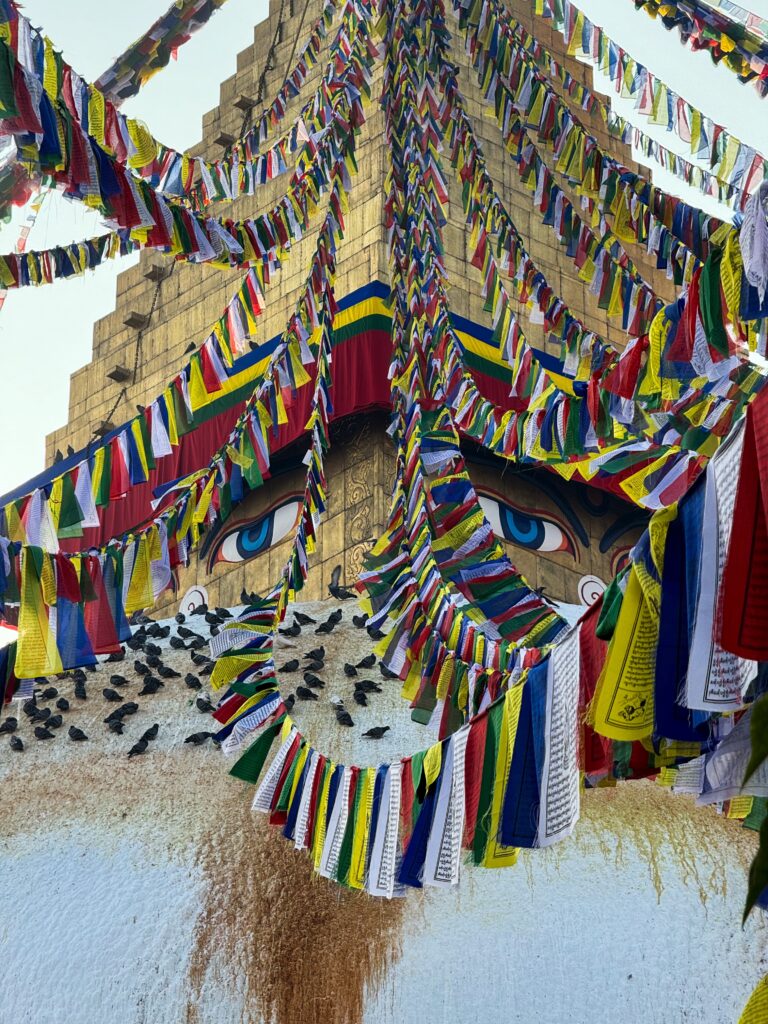
We were dropped right in front of Boudanath and our senses were immediately stimulated all over. The scent of incense and spices wafted through the air. The sounds of bells, chimes, and chanting echo from afar. The sight of all the faithful and pilgrims circumambulating the stupa was a vibe. Plus, the overall energy of this place was very much palpable. What a welcome to Nepal. It was at this moment that it really dawned on me, “I’m in Nepal.”
There were a lot of shops selling Buddhist items and there were hundreds, if not thousands of pidgeons all around, on the stupa, on the roof of the houses, and even on the ground itself. Lisa and I walked around the stupa, before going in further through a small entryway. We got to see some huge prayer wheels and some more tiny ones outside. The people had a strange way of praying here, doing a full-on prostration.
Some people had towels on their hands to make their sliding and bowing much smoother and easier on the wooden boards. After we finished the inner circle, we also did another round around the outer perimeter of the stupa.
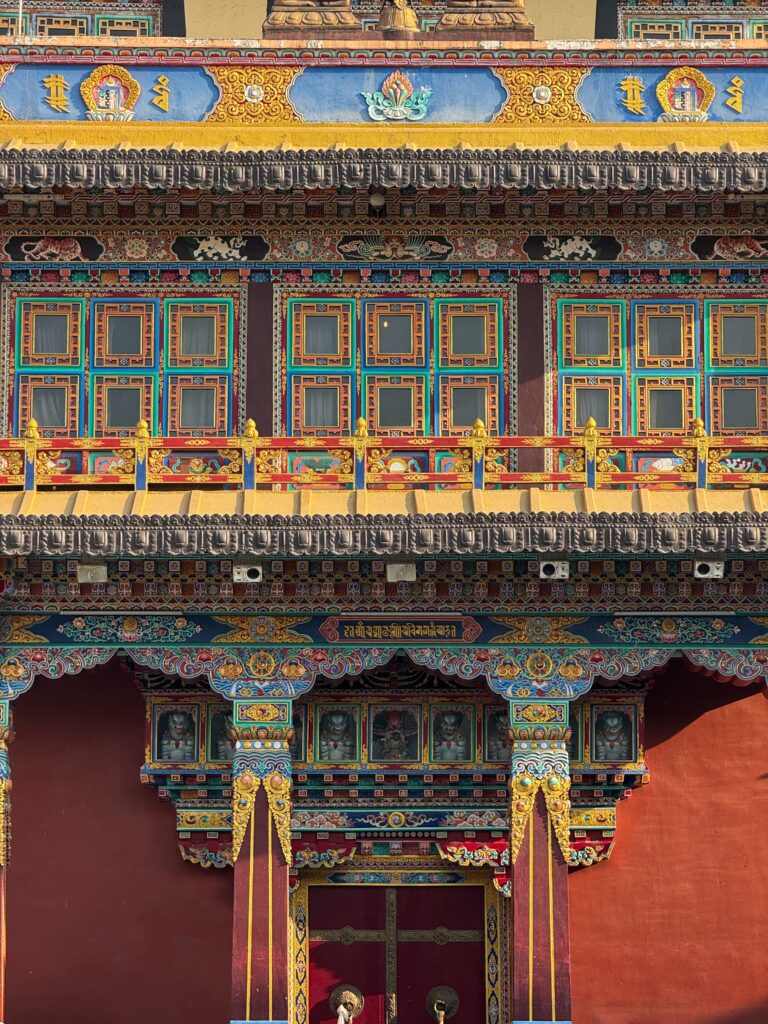
I also asked Lisa if she wanted to stop by the Shechen Monastery, as I really wanted to show her more Tibetan (Vajrayana) Buddhist aesthetics. It was on the way to our next destination, Pashupatinath Temple, so it was all good. We were lucky that we even found a park with a majestic statue of Guru Rinpoche at the center of a pond.
Shechen Monastery was absolutely breathtaking, to say the least. The architecture, colors, and symmetry got us completely mesmerized. While the monks were busy with their daily duties, we approached the temple entrance where the Four Heavenly Kings stood sentinel. The inside was just as extravagant with intricate idols of various Bodhisattvas and Buddhist deities.
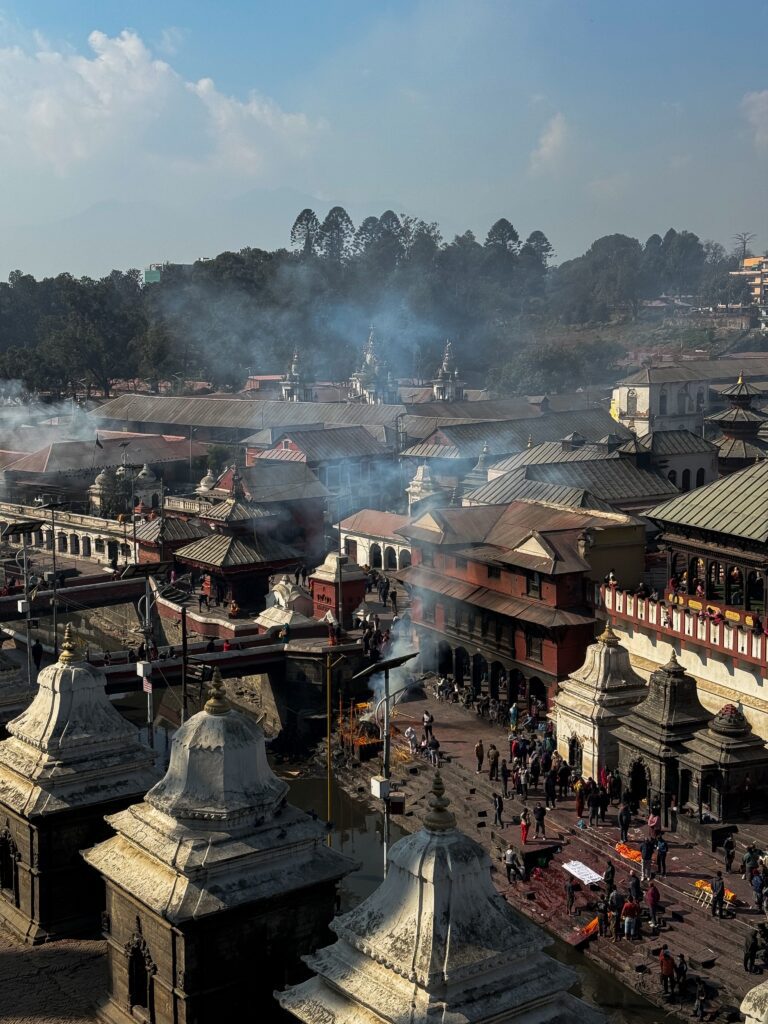
shiva's abode
Lisa lead us to Pashupatinath. It was interesting to see how the neighborhood shifted from Buddhist to Hindu, but throughout our walk, the smell of incense was around every corner which made exploring the roads of Kathmandu such a stimulating and memorable experience.
Soon, we ended up on the opposite side of the actual entrance so we followed the river around the temple complex to the main road where the crowd started to converge. Seems to be the right place. The smell of ganja flowed in the air as this was Shiva’s domain now. We got our tickets and were immediately approached by some tour guides but this wasn’t going to be the day.
We explored a bit on our own but ended up getting snagged by another dude hanging below near a pond where a Shivling stood under an ancient tree. Flanked by both Gauri and Ganesha, we were taught about how to do a puja for them which was quite educational, to be honest, though I also felt like this was going in a direction we wanted to avoid as well.
As we went upwards to get a better view of the main temple (which only Hindus are allowed to enter), we at least got to see a statue of Nandi, Shiva’s bull, and some other parts of the temple.
The temple complex was huge, and indeed, it’s one of the largest Hindu complexes in the world. It took us a while to explore every nook and cranny as much of the structures hugged a hill. We were able to see the cremations happening by the river, which were said to induce a sense of introspection on the impermanence of life and reduce our attachments to materialism. For afterall, who is a better teacher than Death?
From the top, we started to head down the other side back to the first entrance where we first stumbled upon. We took a taxi to go to Kathmandu Durbar Square next, another Unesco World Heritage Site.
kathmandu
We decided to have lunch here first at one of the rooftop restaurants and I got the cottage cheese curry which was surprisingly good and filling and an Oreo milkshake which I couldn’t resist getting. After our lunch, we took a look around the bazaar. I was looking for another bracelet to add to my collection but ended up getting some prayer wheels for some peepz back in Japan.
It seems like we were one of the only few tourists wearing the big ID to signify we paid for the tickets. There were plenty of other entrances around the area that didn’t have much security so I’m pretty sure we would have been able to just sneak past from one of the other entrances but hey, at least we were supporting the local economy by paying.
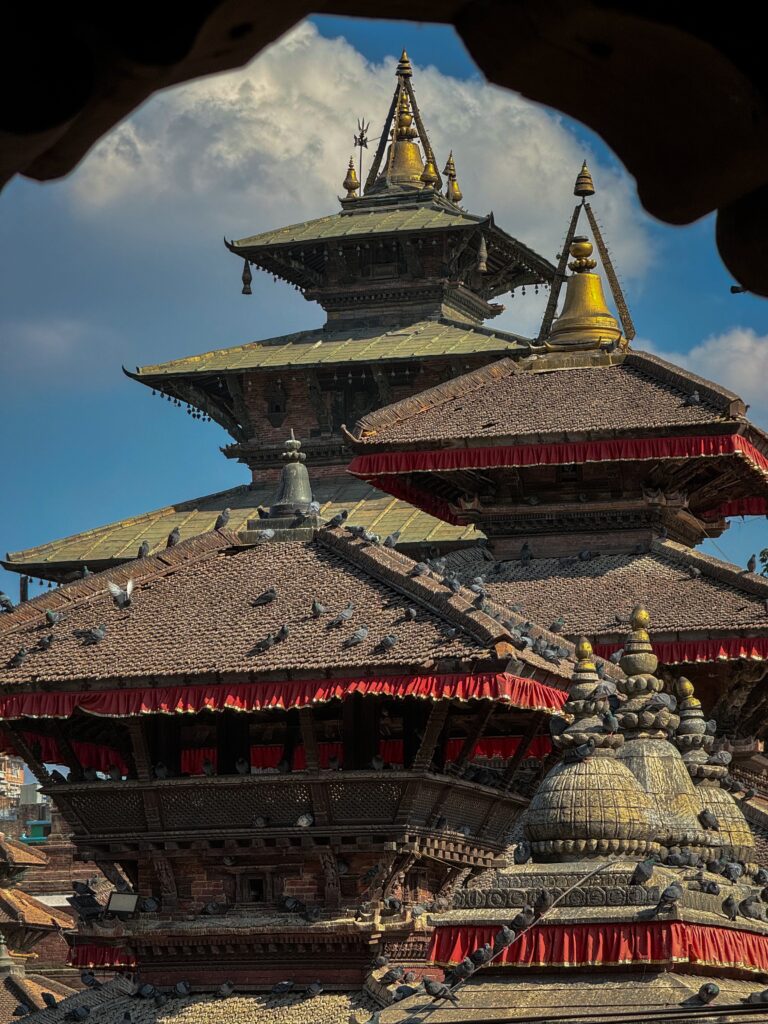
Kathmandu Durbar Square was even grander than both Boudanath and Pashupatinath, it was huge with both Buddhist and Hindu structures towering above each other, as if they were having a contest to see whose spire could first touch the sky. Yet, the syncretism was apparent. It seems like Mahakala, an epithet of Shiva, was a huge deity in this area. Symbolized further with doors with three eyes, and a giant black idol of Mahakala himself in the center square.
There was a museum inside one of the buildings that goes into detail about the history of Kathmandu, a tumultuous one at that.
With plenty of time to kill before sunset, we decided to go to another Tibetan Buddhist monastery. They had construction going on around here which didn’t exactly make it a peaceful visit. Nevertheless, it was a short detour but we were closer to the Monkey Temple, Swoyambhu Mahachaitya, from here.
Before that though, we went to the National Museum. They were closing a bit early today which was okay as we weren’t planning on staying long. The Buddhist artifacts and artworks were some of the highlights of the visit. While we didn’t have time to visit all the buildings, we decided to visit the Numismatic Museum for the last stop (having no idea what “numismatic” meant at that time).
Turns out, “Numismatic” relates to money so we ended up looking at a couple of floors worth of the currency through the ages. It was…interesting to say the least.
the monkey temple
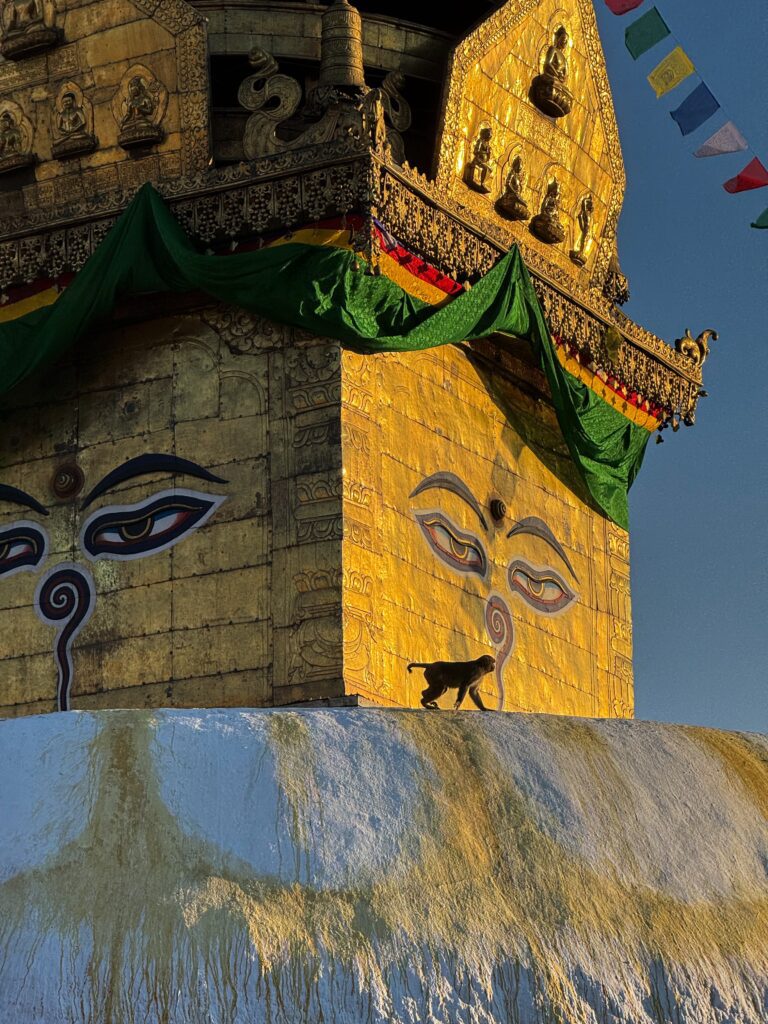
After many detours, it was finally time to begin the journey to the Monkey Temple. After a short hike up, we got to see another one of the Buddha Eyes stupas, except this one was golden. True to its name, there were indeed plenty of monkeys hanging around the temple grounds. The sounds of a chorus playing traditional instruments permeated as we absorbed the atmosphere of the area.
Aside from the main stupa, there were plenty of smaller and medium-sized stupas scattered all around. The highlight here was, of course, the epic views of Kathmandu Valley and the sunset.
We also visited the Maha Manjushri temple on the other side and made our way down towards Buddha Park, where three giant golden statues of Buddhas stood in place. We opted to use a motorbike taxi this time going back to Thamel. I find it’s a much more immersive way of seeing the city, not through glass windows, but by feeling the wind caress your face as the world around you goes by.
Back in Thamel, Lisa and I went to find dinner which ended up being in the form of momos, Nepalese dumplings. I also got to buy a sweet chillum that I was excited to use with my friends back home.

a day out in lalitpur
Another day in Kathmandu, we woke up to the same breakfast we had the day before. Lisa started to have some problems with her throat, similar to my experience in Bangladesh. I guess Kathmandu has its own share of pollution.
We were planning on visiting both Lalitpur and Bhaktapur today. I suggested that we try to go via public transport to get a better feel for the local experience. We headed to Ratna Park which took around 15 to 20 minutes, then we started to ask around for the correct ride going towards Lalitpur’s Patan Durbar Square, with various results. Eventually, a driver said they were headed there so we got on that one.
It was surprisingly comfortable inside, air-conditioned, and not too crowded. Perhaps we got on a good one. However, we passed by Patan a few blocks and I don’t think it was actually stopping by the Durbar Square so we asked to be dropped at the next stop where we walked the rest of the way.
We first stopped by Oku Bahal, a Buddhist temple with the Vajra symbol in front of a white stupa. It was smack dab in the middle of some apartments arranged in a square. Lalitpur had a very unique city design and architecture, distinct from Kathmandu.
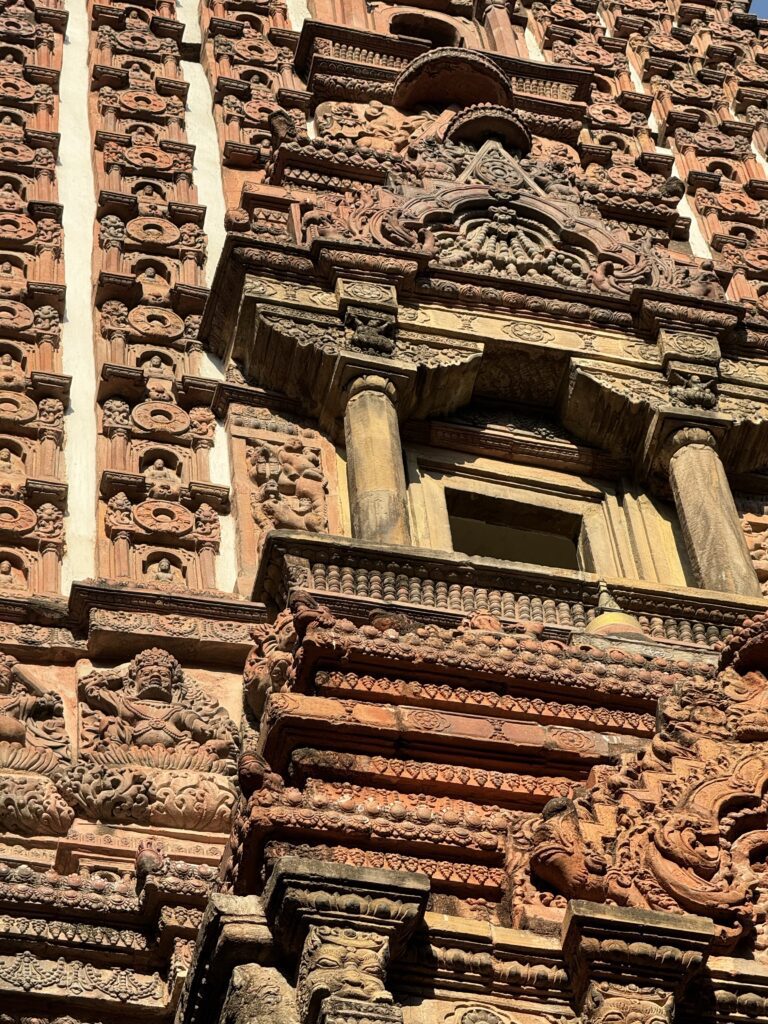
The next stop was the Mahabuddha Temple, surprisingly a Theravada Buddhist temple with Khmer architecture. It was so out of place as this sort of temple is usually found in Thailand and Cambodia based on my own experience. Nevertheless, it was awesome to see such diverse Buddhist temples all just a stone’s throw away from each other.
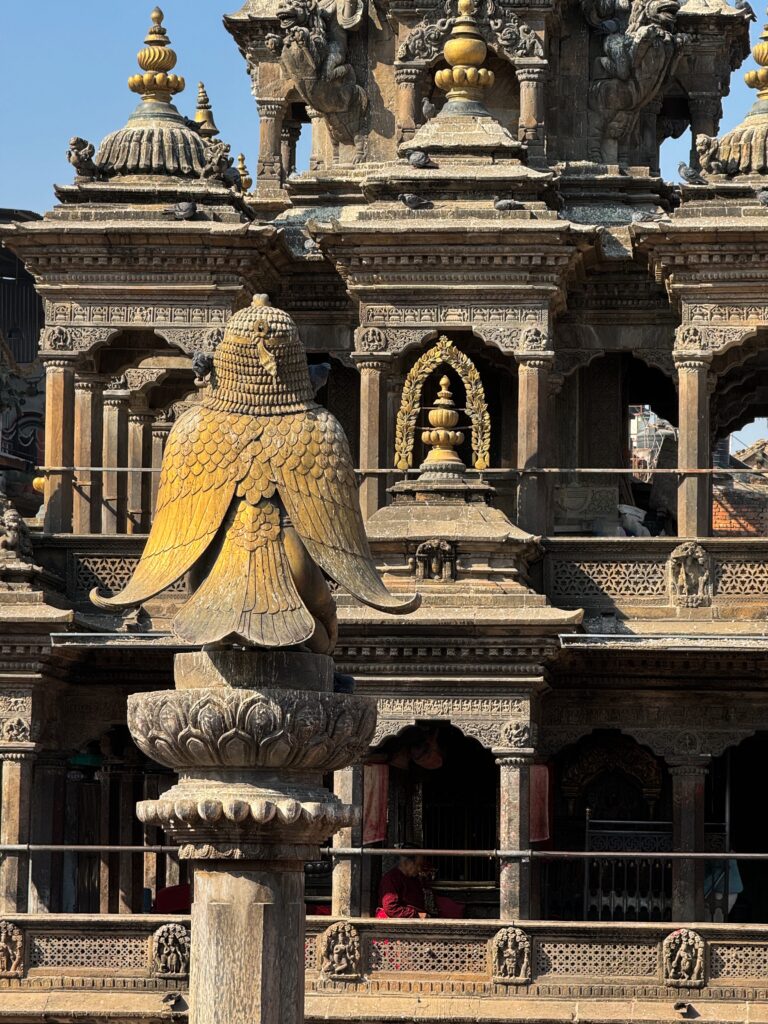
A couple of blocks away was Lalitpur’s Patan Durbar Square. We had to buy our tickets here which gave us access to the main area which was like a complex of some sort, now turned into various museums. Lisa and I spent a long time here, taking some time away from each other and just exploring on our own.
I eventually saw her again after passing through several areas, where we then continued outside to see the other structures around the square. The architecture of the temples here were next level and entirely different from Kathmandu’s, seeing as Lalitpur was also a previous capital of a different king.
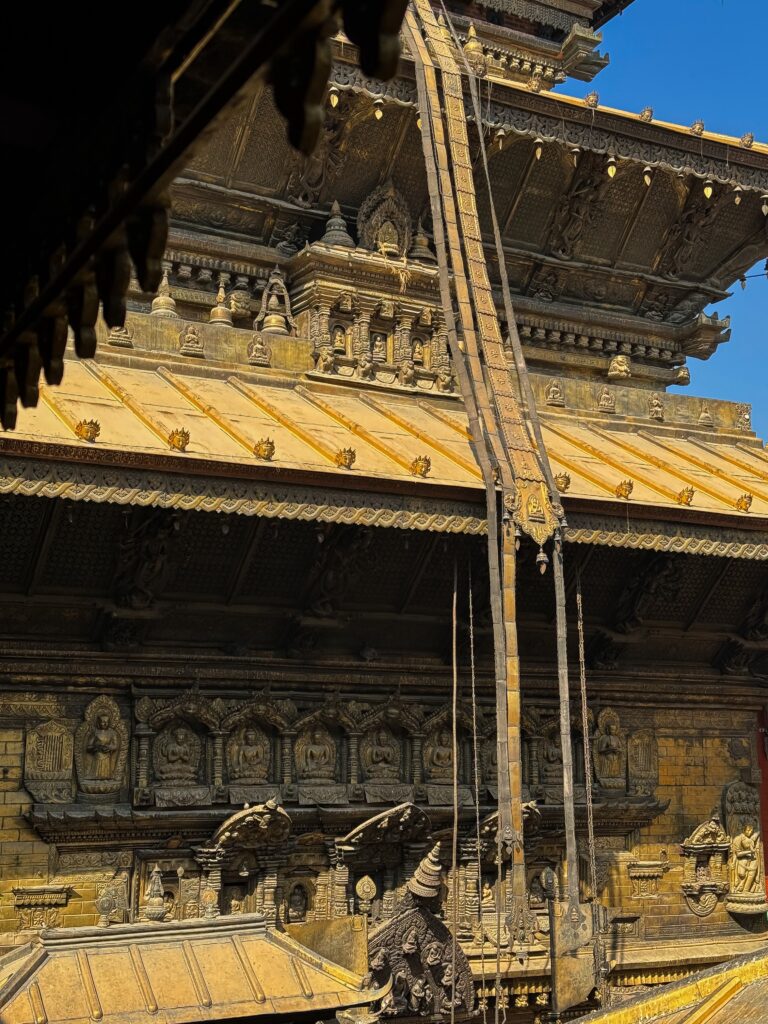
Next, we went to Hiranya Varna Mahavihar, the Golden Temple. This one was particularly impressive both in scale and grandeur. The whole temple was indeed coated with gold, including the Shakyamuni Buddha statue which was glamorous to look at.

Continuing on our exploration, we got to Shree Bagalamukhi Temple next. A Hindu temple where a towering pagoda stood looming from afar. Inside was much peaceful, with devotees lighting incense and going around.
It was really fascinating for me to find out that there was a shrine dedicated to Kunti, one of the Five Virgins, here. A prominent figure from the Sanskrit epic, Mahabharata. I was also struck with the fragrance of the incense, and I tried to ask around but I couldn’t find the source at all.
With most of the spots out of the way, I asked Lisa if there was anywhere else she wanted to go. She pointed out the Ahsoka Stupa which was mentioned in one of the museums back at Patan Durbar Square.
“Sure, let’s go.”
We found it in the center of another apartment block, a much larger white stupa with the usual Buddha eyes and prayer flags connected to the buildings. I mused out loud how it must be like to wake up in the morning with those eyes staring at you outside the window.
With most of the sites in Lalitpur covered, we decided to head back to the square to hail a taxi to Bhaktapur as our confidence had dwindled in using public transportation, especially as we were now going even further away from Kathmandu.

beautiful bhaktapur
After visiting Lalitpur, our next heritage site was Bhaktapur. We didn’t realize just how many surprises were in store for us here.
Our taxi dropped us off right in front of the ticket booth where we once again got our giant IDs and were quickly approached by some tourist guides. We decided to get some lunch first. With the allure of trying some traditional Newari cuisine, we got whisked off into one of the local restaurants. We ate deeper in the restaurant which was part of a block of other buildings. A dilapidated stupa that once stood in the center now turned to rubble with vegetation growing around it.
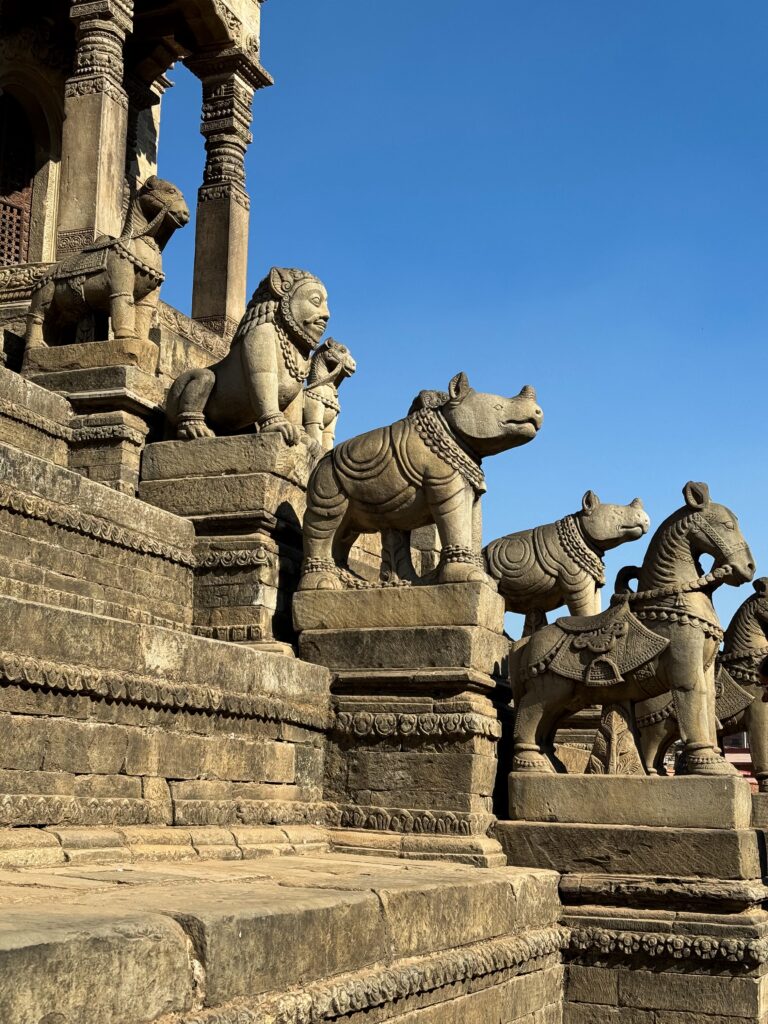
After lunch, we finally went inside Bhaktapur Durbar Square, where a myriad of other structures stood waiting to be explored. It was much larger (and much more expensive) than both Kathmandu and Lalitpur but it was very much worth it just from the first sight alone. Nepal’s tallest pagoda, Nyatapola Temple, was here, the Palace with 55 Windows, and plenty of other temples scattered around. It was like a playground of sorts and I was all for it.
I was quite ecstatic to find a very unique angle to capture the various structures of Bhaktapur and also I was able to finally find a bracelet that passed my aesthetics check. Bhaktapur was quite kind to us!
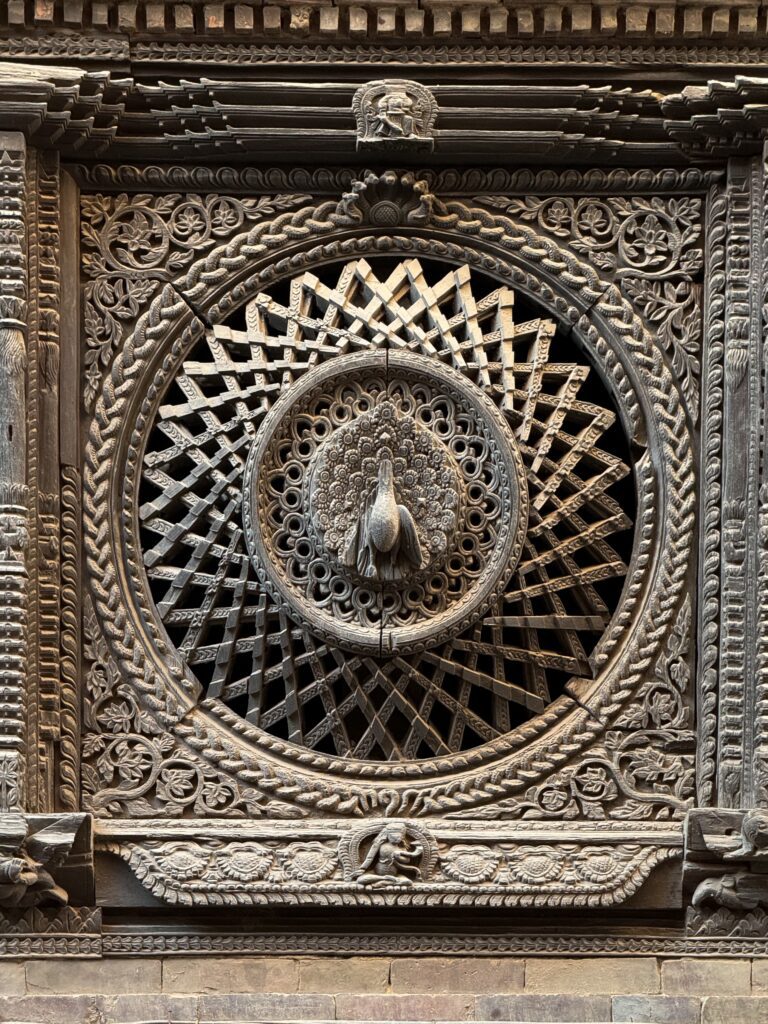
We went to the Pottery Square next to see some artisanship in action. We also went to find the famous Peacock Window, apparently known as the Mona Lisa of Nepal.
With most of the sites of Bhaktapur out of the way, I asked Lisa if she still wanted to do anything and she found the Suryabinayak Ganesh Temple right around the outskirts of town. We found a taxi driver who’d take us there and then back to Kathmandu.
A few flights up the stairs led us to a temple devoid of people yet filled with plenty of dogs. Six dogs or so came out to play and be pet, they were quite dirty but the cuteness was irresistible.
We began our hike but my instincts were telling me this was the wrong way, we were going off-road and further off-trail but Lisa said to just try so we went further. But I felt like this route would be taking us deep into the mountain’s forest and not really up to get some summit views so we backtracked and found the right path. The views were great but we still had some more time. There was a nearby temple below, the Likha Narayan Temple.

Upon our approach, we heard some traditional music playing and found people dancing on the temple grounds. It seemed fun so we popped right in and watched them with glee for a while. I was then approached by a woman in red, in fact, all the women were wearing red.
She then introduced herself as Newari. That’s when it dawned on me and I turned to Lisa “Oh they’re indigenous?” She then invited us to dance with them, and danced we did. I’d say this was one of the highlights of the day, it was just so fun and smiles all around. No language was needed to enjoy each other’s company in this moment. After several dance numbers, we sat down for a bit and were given some food and drinks, the same kind of food we had in the Newari restaurant earlier. This was dinner right here too, great times.
The woman explained they were dancing to Ram Lila, which I assumed pertains to the Ramayana which makes sense as the temple was dedicated to Vishnu.
We were then invited to dine with the rest of the Newari. They sat on the floor and ate with their right hands, just like in Bangladesh even though they were a Muslim country. So I was thinking it’s more of a regional custom than a religious one. They gave us even more food and as we ate, the sun was setting behind us. Coating the temple grounds and our faces with a radiant orange glow.
Realizing it was beginning to get late and that we had to get back to our taxi driver, we pardoned ourselves and said goodbye, “alvida”, before beginning the hike back down.
When we got back to Kathmandu, we finally got to meet with Tej, my contact for arranging our trek to the Himalayas as we were going to Pokhara the next day. The adventure continues.