
Sacred Geometry, a term coined in the ancient world, represents an exploratory journey into the fundamental patterns, structures, and shapes found in the universe around us.
This philosophy underscores the belief that the cosmos, in all its vastness, follows an order – a harmony of proportions that can be decoded into specific geometrical forms.
These forms are considered sacred, as they embody the divine blueprint of creation and the interconnectedness of all existence.
Sacred geometry encompasses a wide range of figures and symbols, from simple patterns like circles and squares to intricate designs such as the Egg of Life, Seed of Life, and, of course, today’s topic: the Metatron’s Cube.
Metatron’s Cube is one such potent symbol in sacred geometry. Named after the Archangel Metatron, who is said to govern the Tree of Life in the Kabbalistic tradition, this intricate form encapsulates a hidden three-dimensional world that serves as a key to understanding the very fabric of reality as we know it!
Table of Contents
Toggle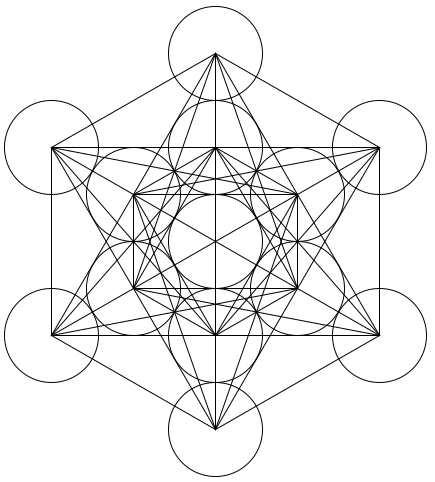
What is the Metatron's Cube?
Metatron’s Cube is a two-dimensional geometric figure created from 13 equal circles with lines extending from the center of each. This design is a foundational element of the sacred geometric figure known as the Flower of Life.
Basically, like all Sacred Geometry symbols, Metatron’s Cube is like a map to understanding the universe.
But what sets Metatron’s Cube apart is its hidden depth.
If you look closer, you’ll discover that it contains every shape that exists within the universe. These shapes are known as the Five Platonic Solids, named after the ancient Greek philosopher Plato.
While the Metatron’s Cube is named after the Archangel Metatron. In Islam, Jewish mysticism and early Christian Gnosticism, Metatron is depicted as a powerful figure involved in divine creation.
He is said to oversee the flow of energy in a mystical cube, which contains shapes representing all the patterns of creation.
Who is Archangel Metatron?
When it comes to the esoteric world, it doesn’t get much more intriguing than the story of Archangel Metatron.

Metatron in Judaism
In Judaic traditions, Archangel Metatron is often seen as the right-hand man… or should I say, right-hand angel of God Himself.
But this wasn’t always his role.
Metatron was once a being of mortal origins – specifically, as the figure of Enoch from the Old Testament.
Enoch, a man of notable piety and righteousness, was said to have walked with God. So profound was their communion that God decided Enoch was too precious for the mortal world.
In an event of divine ascension, Enoch was taken up to the heavens, skipping the bitterness of death, and transformed into the celestial entity we now know as Metatron.
As Metatron, he became God’s celestial scribe, recording all events, actions, and thoughts that ever occur in the universe.
His proximity to the Divine Source made him privy to cosmic secrets and the unfolding of all earthly and heavenly events.
Beyond this, the Zohar, a cornerstone text of Kabbalah, attributes Metatron with leading the people of Israel through the wilderness after their Exodus from Egypt.
The scholar Ibn Hazm adds another dimension to Metatron’s role, stating that Jews not only recognize him as an angel but also honor him as a lesser god for ten days each year.
This celebration, potentially referring to Rosh Hashanah, may connect to the Merkabah mystical belief that Metatron partook in the creation of the world.
Metatron in Islam
References to this powerful archangel can even be found within the Quran itself, in the context of Uzair (known as Ezra in the Bible).
As per Surah 9:30-31, Uzair is venerated as a son of God by Jews, and there’s a line of thought in Merkabah Mysticism that identifies Uzair with Metatron.
Early Islamic scholars, like Al-Kindi and Al-Masudi, also allude to the name “Metatron”, hinting at his influence within early Islam.
In Islamic esoteric tradition, Metatron is not only included among the canonical Archangels but also depicted as the angel of the veil by the esteemed scholar Al-Suyuti.
This title suggests that Metatron is privy to mysteries hidden from mortal comprehension.
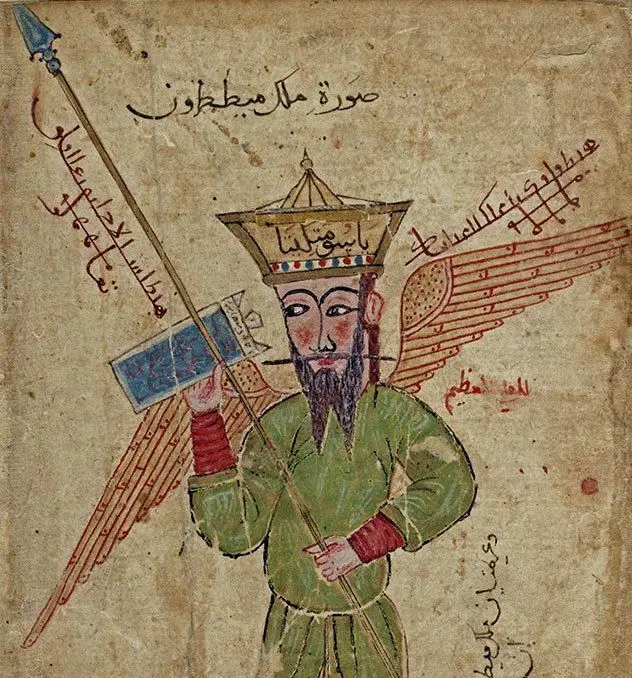
Metatron’s image in the magical works of renowned Islamic scholar and Sufi, Ahmad al-Buni, is also interesting.
Al-Buni portrays Metatron as a regal figure, crowned and armed with a lance that might represent the Staff of Moses.
Beyond these depictions, Metatron is invoked in Islamic magical practices for protection against various malevolent forces such as evil jinn, sorcerers, and other magical threats.
The Metatron's Cube and Sacred Geometry
What is Sacred Geometry?
Think of Sacred Geometry as the language of the universe, communicated not through words, but through shapes and patterns.
A language that exists everywhere around us – in the crystalline structure of a snowflake, the fractal pattern of a fern leaf, or the swirling spiral of a galaxy.
Sacred Geometry, simply put, is the exploration of these universal patterns that govern the construction of everything in the universe.
It’s as though the universe itself is a work of art, crafted with mathematical precision and aesthetic brilliance.
Now, you might wonder, why is it called “sacred”?
Well, it’s because these patterns aren’t just visually captivating, they’ve been a part of spiritual symbology around the world since ancient times!
Go into the past, and you’ll find that sacred geometry was understood and utilized by ancient civilizations too.
The Grecians with their perfect proportions in architecture, the Egyptians with their monumental pyramids, all tapped into the principles of sacred geometry!
Metatron's Cube and the Tree of Life
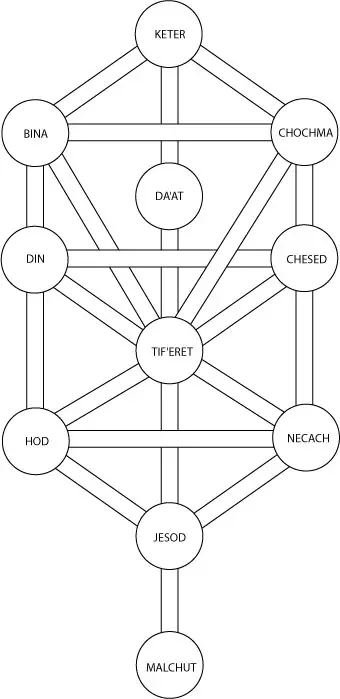
In the profound spiritual philosophy of Kabbalah, the Tree of Life is an emblematic symbol, embodying the divine structure of the universe and the nature of reality itself.
This sacred schema consists of ten spheres known as sefirot. Each representing a different aspect of God, and the paths that connect them, which symbolize the dynamic flow of divine energy.
Interestingly, even the Tarot cards use the Kabbalistic Tree of Life as a guiding principle.
Among the many celestial entities associated with the Tree of Life, Metatron holds a place of high distinction. Specifically, he is linked with Kether, the topmost sefirah.
Kether, often translated as “Crown,” signifies the primal stirrings of existence, the divine light in its unmanifest state.
It’s the source from which all the other sefirot emanate, the sublime point of unity that contains within it the potential for all the multiplicity of creation.
As the steward of Kether, Metatron is seen as the supreme channel of divine influx. This gives him a unique role in the workings of the universe as per Kabbalah.
It is through Metatron that the divine light descends down the Tree of Life, branching out into the different sefirot and giving life to the various aspects of creation.
This divine light, in Kabbalistic terms, is the creative energy of God, and Metatron is seen as the mediator, the bridge between the divine and the manifest.

Metatron's Cube and the Platonic Solids
The five Platonic solids are: the tetrahedron, cube, octahedron, dodecahedron, and icosahedron. They are the only regular polygons in three dimensions, meaning they have all edges of the same length and angles of the same size. You can find that each shape is also attributed to a specific chakra.
- Tetrahedron
The tetrahedron is the simplest of the solids, comprised of four equilateral triangles. It represents the element of fire and is linked with the Solar Plexus Chakra, the center for personal power and acceptance.
- Cube
The cube or hexahedron consists of six squares. It is associated with the element of Earth and relates to the Root Chakra, the center for physical awareness and stability.
- Octahedron
The octahedron is made of eight equilateral triangles. It corresponds to the element of air and is tied to the Heart Chakra, the center for love and healing.
- Dodecahedron
The dodecahedron is composed of twelve pentagons. Representing the universe or ether, it’s associated with the Higher Chakras (Throat, Third Eye, and Crown), centers for intuition, spiritual awareness, and enlightenment.
- Icosahedron
The icosahedron, featuring twenty triangles, symbolizes water and corresponds to the Sacral Chakra, the center for emotional connection and creativity.
In Metatron’s Cube, each of these five Platonic Solids fits perfectly. They can be drawn or extracted from the lines and intersections within the cube.
This represents the belief that everything in the universe, at its most fundamental level, is created from these geometric patterns and can be represented in the Metatron’s Cube. Mindblown.
Metatron's Cube Symbolism
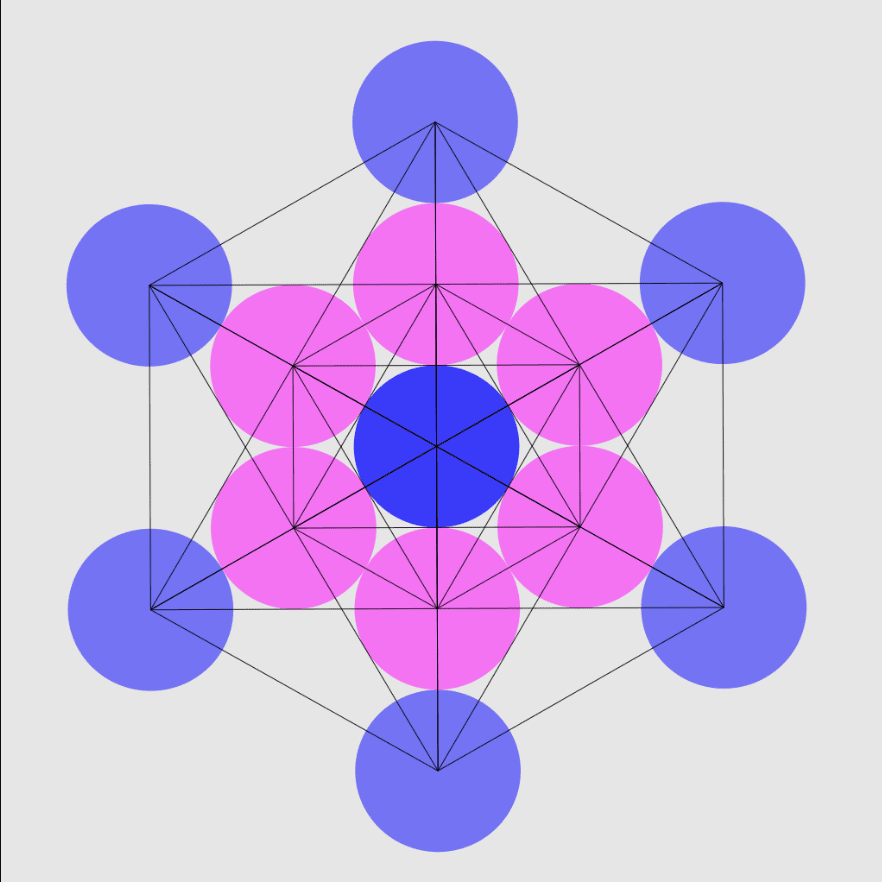
Metatron’s Cube appears to be a complex piece of sacred geometry, yet it springs from a simple foundation: thirteen equal circles with lines extending from the center of every circle to the center of all the other twelve circles.
That’s it. Sounds simple, right?
Yet, this straightforward concept blossoms into a multidimensional form.
At its heart, Metatron’s Cube represents the weaving together of the “Macro” and the “Micro” cosmos.
Each circle can be seen as an individual cell, atom, or even a quantum particle – the “Micro.”
Together, these circles form the “Macro,” revealing how all elements of the universe are connected.

The Metatron's Cube Explained
The thirteen circles of Metatron’s Cube are interlaced to form a grid. This grid, in turn, forms a series of geometric shapes.
Among them are the five Platonic Solids – the tetrahedron, hexahedron, octahedron, dodecahedron, and icosahedron.
Each of these solids is a polygon whose faces are identical in shape and size, whose edges are also of equal length.
The Platonic Solids are elemental building blocks of the universe, associated with the elements of fire, earth, air, spirit, and water, respectively.
Interwoven within these solids, we also see the Vesica Piscis, Seed of Life, and the Fruit of Life, a component of the larger design known as the Flower of Life.
The Fruit of Life consists of 13 circles (like Metatron’s Cube), which are believed to represent the 13 systems of knowledge that allow us to understand the universe.
Metatron's Cube and Spirituality
Metatron’s Cube has increasingly found its way into the world of holistic practices due to its profound spiritual significance. Here’s how:
-
Reiki: In energy healing practices, such as Reiki, practitioners often use Metatron’s Cube as a tool to channel healing energy. They visualize this sacred geometry to connect with the universal life force and facilitate healing.
-
Aura: In esoteric practices, Metatron’s Cube is also associated with the aura. The thirteen circles represented in the cube are said to correspond to the thirteen main joints in the human body, each governing specific aspects of our energetic body or aura.
-
Meditation: Many people employ Metatron’s Cube during meditation, visualizing it or using it as a mandala to better focus their minds or even as a gateway to higher states of consciousness.
As you may have noticed by now, the allure of Sacred Geometry isn’t confined to the outer world; it extends to the realm of human consciousness.
The Sri Yantra in Hinduism, the Tibetan Mandalas, and even the Sak Yant Tattoos of Thailand are all powerful geometric symbols used for inducing a resonance between external forms and internal consciousness.
It’s as if these geometric patterns serve as keys to unlock latent capacities of our minds, connecting us with the universe’s wisdom in really tangible ways.









2 Responses
great site
Hi Rey,
Thank you very much for your kind comment!