
The Newari people are the indigenous inhabitants of the Kathmandu Valley in Nepal. They are one of the most historically prominent communities in Nepal, known for their vast contributions to art, culture, cuisine, and architecture.
This culture reflects the geographical centrality of the Kathmandu Valley in Himalayan culture, characterized by a complex blend of both Hindu and Buddhist elements evident in their festivals, rituals, and everyday life.
Understanding Newari culture offers insight into the rich cultural mosaic of Nepal, showcasing a community that has significantly shaped the historical and cultural landscape of the region. By exploring and documenting Newari traditions, arts, and social practices, this article aims to celebrate and promote the enduring legacy and vibrant life of the Newari people.
Table of Contents
Toggle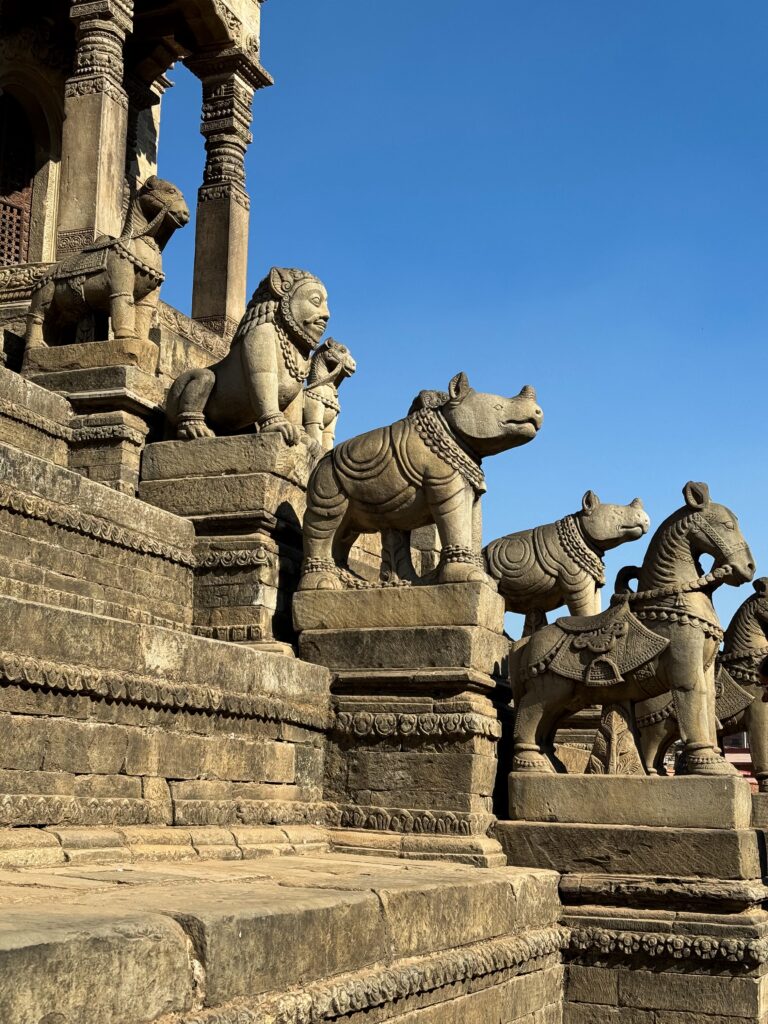
History of the Newari
The Newari community’s roots in the Kathmandu Valley trace back to at least the 4th century AD, though the area has likely been inhabited since the Neolithic era. The rich alluvial soils of the valley, coupled with its strategic location along key trade routes, made it an ideal settlement area. Historical records suggest that the Newars are the descendants of the original settlers of the valley.
The Newars played a pivotal role in the development of Nepalese civilization, particularly during the medieval period. As skilled artisans, traders, and farmers, they helped to establish the economic and cultural foundations of the region. Their contributions to architecture, sculpture, and urban planning can be seen in the exquisite temples, palaces, and public squares of the valley, particularly in cities like Kathmandu, Lalitpur (Patan), and Bhaktapur. We were even able to dance and dine with some Newari over at Bhaktapur, you can read more about that here!
From the Licchavi dynasty to the Malla kingdoms of the medieval period. The Newars were central to these developments, whether through their intricate artistry in the palaces and temples or through their management of trade routes that connected Tibet and India. The influence of Newari merchants and craftsmen extended well beyond the borders of Nepal, impacting trade and cultural exchanges across Asia.
Cultural Concepts of the Newari
Nyaya
In traditional Newari culture, the concept of nyaya (justice) refers to a form of community justice and moral order that governs social interactions. This concept emphasizes fairness, accountability, and the resolution of disputes through community mediation rather than formal legal mechanisms. The elders or respected community members often play a crucial role in adjudicating disputes according to customary laws and practices.

Dharma
Newari understanding of dharma intertwines with both Hindu and Buddhist philosophies, where it encompasses duties, rights, laws, conduct, virtues, and the “right way of living.” This cultural concept shapes individual behavior and community expectations, guiding Newaris in maintaining social order and religious devotion.
Izzat
Izzat in Newari culture relates to the concept of honor and respect. It is closely tied to family reputation and individual dignity, dictating social interactions and the maintenance of social status. Protecting one’s izzat involves adhering to community norms, engaging respectfully with others, and upholding family traditions, which in turn affects marriage alliances, social mobility, and community leadership roles.

Laakha
Laakha (face) concerns the maintenance of social appearance and dignity. Similar to the concept of “saving face” in other Asian cultures, in Newari society, individuals strive to avoid actions that could bring shame to themselves or their families. This concept influences personal behavior and decision-making, often prioritizing community perception and social harmony over personal desires or truths.

What is the Religion of the Newari?
Religion plays a central role in Newari life, just like the Tharu and Gurung. Hinduism, Buddhism, and indigenous practices have coexisted harmoniously in the Kathmandu Valley for centuries. The Newari religious framework is uniquely syncretic, where gods and rituals from both Hinduism and Buddhism are integrated into a cohesive system of belief and practice.
This integration is evident in the shared temples and festivals, where deities and rituals from both religions are revered and celebrated side by side.
Newari Hindus worship a variety of Hindu gods such as Shiva, Vishnu, and Durga, while their pantheon also includes local deities specific to the Newar community, like Ajima.
Newari Buddhists primarily follow the Vajrayana tradition, but with many tantric influences and the worship of both Bodhisattvas and Hindu deities.
Newars also follow a set of animistic and shamanistic practices, which reflect their deep reverence for nature and ancestral spirits. These practices often involve rituals that are specific to certain clans and localities within the Newari community and include offerings, spirit possession, and shamanic healing.
What are the Traditions of the Newari?
Guthi
In Newari culture, rituals permeate every aspect of life, from daily routines to major festivals. Traditional priests, known as “Guthi“, play a crucial role in overseeing these rituals. A Guthi is both an organization and a group of individuals responsible for maintaining community temples, organizing festivals, and performing religious ceremonies. These priests ensure that the traditions and rituals are passed down through generations and remain integral to community identity. Their responsibilities extend beyond religious functions to include social welfare and community management.
Bhoj
Feasts, or “Bhoj“, are a cornerstone of Newari culture, serving as both a social gathering and a religious observance. These communal meals are often lavish and involve the entire community. They are typically held during festivals, religious ceremonies, and important life events such as births, weddings, and funerals. Bhoj strengthen communal bonds and reaffirm social hierarchies and roles within the Newar community. The sharing of food during these feasts is considered a sacred duty and a form of blessing.
Traditional Attire
- Men: Traditional attire for Newari men typically includes the “Daura Suruwal” or “Labeda Suruwal“. This outfit consists of a knee-length sleeved shirt that ties at the sides, paired with trousers. During special occasions, men wear a “Tapalan“, a type of waistcoat, and a “Topi“, a traditional cap.
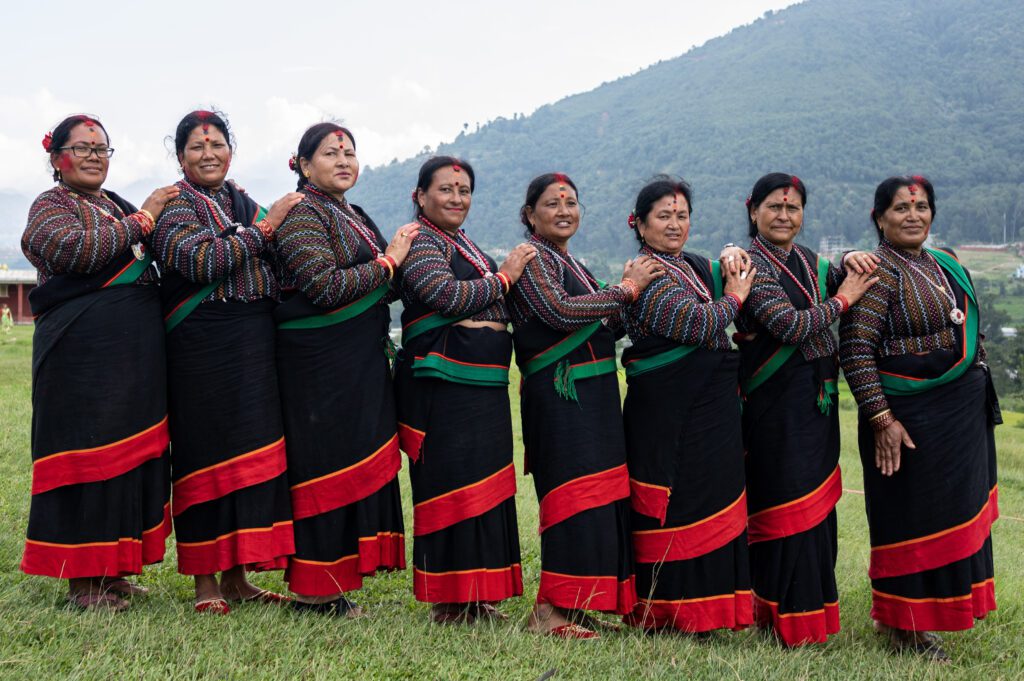
- Women: Newari women traditionally wear the “”Haku Patasi“, a black sari with a red border, draped in a unique style that is distinct to the Newari culture. Alternatively, women may wear a “Gunyu Cholo“, a blouse paired with a sari-like draped fabric. This attire is often complemented with a shawl or a scarf.

Newari Traditional Dance
Newari dance forms are not only entertain but also convey spiritual narratives and historical legends through intricate movements and expressive costumes:
- Lakhey Dance: The Lakhey dance is one of the most iconic in Newari culture, featuring a dancer dressed as Lakhey, a demon god known for being both fearsome and protective. Performed primarily during the Indra Jatra festival, the dance involves vigorous movements, dramatic gestures, and a mask that portrays the fearsome face of Lakhey.
- Bhairav Dance: The Bhairav dance is performed in honor of Lord Bhairav, a fierce manifestation of Shiva. This dance is characterized by strong, dynamic movements that capture the god’s destructive and protective aspects.
- Nyatapola Dance: Performed during the festival of Bisket Jatra in Bhaktapur, this dance is named after the famous Nyatapola Temple (the tallest pagoda in Nepal). The dance involves a representation of the deities housed within the temple and is part of the procession that features a tug-of-war between different parts of the city.
Newari Traditional Music
Newari music is an integral aspect of the cultural heritage of the Newar community, featuring a variety of traditional musical instruments:
Dhimay: A large cylindrical drum played with hands, it’s known for its deep, resonating sound that can be heard over long distances.
Bhushyah: This is a smaller drum, often played in pairs, the rhythm from Bhushyah is usually faster and helps in setting a lively tempo for dances and processions.
Khainjadi: A type of tambourine used in Newari music, which is common in both folk and classical music settings.
Newari Cuisine
Choila: This is a spicy grilled or smoked meat dish, typically made from buffalo meat, which is marinated with spices and mustard oil.
Momos: While momos are enjoyed across Nepal, Newari momos have their unique twist, often filled with buffalo meat and served with a variety of traditional Newari spices and sauces.
Sukuti: This dish consists of dried meat (again, usually buffalo) that is either eaten dry, spiced, or rehydrated and cooked with other ingredients. It’s a common snack paired with alcoholic beverages.
Kwati: A soup made from nine different types of sprouted beans. It’s particularly popular during the festival of Janai Purnima, where it is eaten to enhance health and strength.
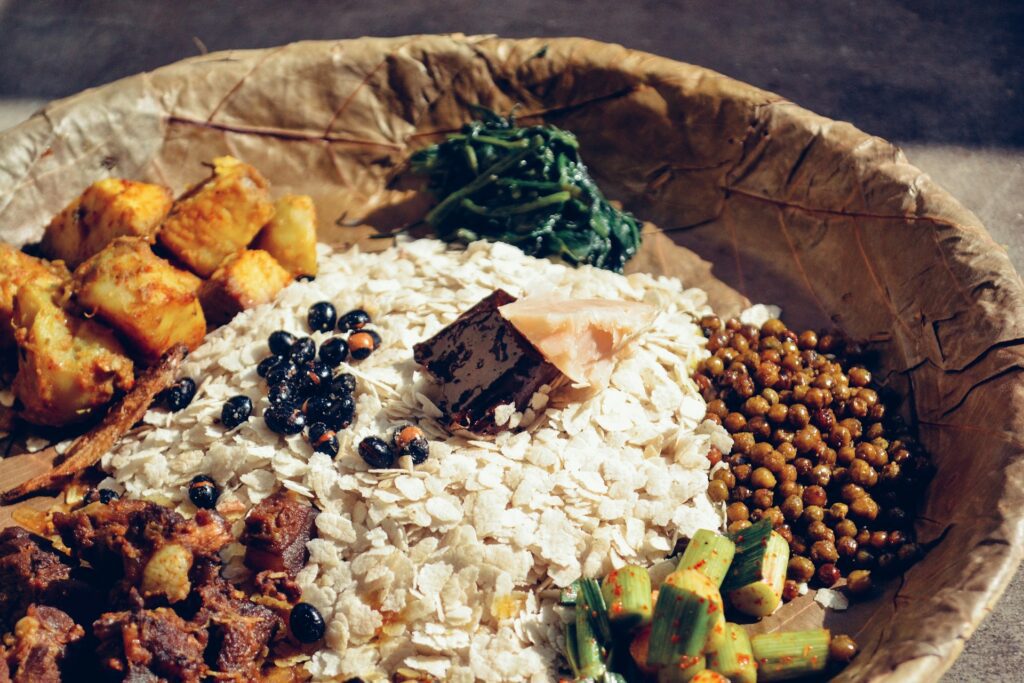
Samay Baji: An traditional Newari platter that includes a variety of items such as beaten rice, barbecued meat, boiled-then-fried eggs, black soybeans, and a selection of pickles.
Bara: A savory pancake made from lentil paste, which can be plain or mixed with minced meat or vegetables.
Chatamari: Often referred to as the “Newari Pizza”, this is a rice crepe topped with ingredients like chopped onions, minced meat, egg, and spices.
Yomari: A sweet treat made of rice flour dough stuffed with a mixture of molasses and sesame seeds. It is particularly significant during the Yomari Punhi festival, which marks the end of the rice harvest.

What is Newar Language like?
The Newar language, known as Nepal Bhasa, is a Sino-Tibetan language spoken predominantly by the Newari community in the Kathmandu Valley.
Historically, Nepal Bhasa was the administrative language of the Kathmandu Valley during the Malla kingdoms, which is evident from the vast array of historical documents, inscriptions, and literary works from that period.
The literary tradition of Nepal Bhasa is one of the oldest in Nepal, with texts dating back to the 12th century. The literature in Nepal Bhasa includes a wide range of genres, including drama, poetry, stories, and religious texts. The “Gopalarajavamsavali“, the oldest known chronicle in Nepal, was written in Nepal Bhasa.
Today, Nepal Bhasa faces challenges related to its survival and growth. Although it is one of the national languages of Nepal, its speakers are relatively few, and the language is often overshadowed by Nepali, the official language.
Traditional Newar Festivals
Indra Jatra
Indra Jatra is one of the most celebrated festivals in the Kathmandu Valley, marking the end of the monsoon season. It is dedicated to Indra, the king of heaven and the god of rain. The festival features the Kumari Jatra, the chariot procession of the living goddess Kumari, along with dances of deities and demons including the famous Lakhey dance. Streets are filled with music, masked dances, and religious displays. It also includes the erection of the lingo, a ceremonial pole, symbolizing a call for the return of the departed souls to heaven.
Bisket Jatra
Celebrated in Bhaktapur and other parts of the Kathmandu Valley, Bisket Jatra heralds the Nepali New Year and is known for its dramatic chariot processions. The festival involves a tug-of-war between different parts of the town, each trying to pull a huge chariot in their direction. It features a symbolic battle between Bhairab and Bhadrakali, culminating in the chariot being taken to a specific location where festivities continue with traditional music and dance.
Gai Jatra
Gai Jatra or the Cow Festival is another significant festival which occurs in August or September and is dedicated to remembering the deceased. Families who have lost a relative during the past year participate in processions, leading a cow or young boys dressed as cows. The festival includes satirical and comedic performances and serves as both a remembrance of the dead and a relief from the grief of loss. The belief is that the cow helps guide the departed souls to heaven.
Customs of the Newari
“Machaboo byanke” or rice-feeding ceremony, which takes place when the child is about six months old. During this event, the baby is fed rice for the first time in a festive environment, surrounded by family and friends.
Newari weddings are elaborate affairs involving multiple rituals that symbolize the union of two individuals and their families. One of the central ceremonies is the “Ihi“, or “Bael bibaha“, a pre-puberty marriage where girls are married to the bael fruit (wood apple), which represents Lord Vishnu. This ritual is believed to ensure that the girl becomes and remains a widow of Vishnu rather than of any mortal man. While the actual marriage ceremony involves rituals like “Janti”, the procession of the groom’s party to the bride’s home, and “Kayeta Puja”, a ceremony where the groom is worshipped as an incarnation of Lord Vishnu.

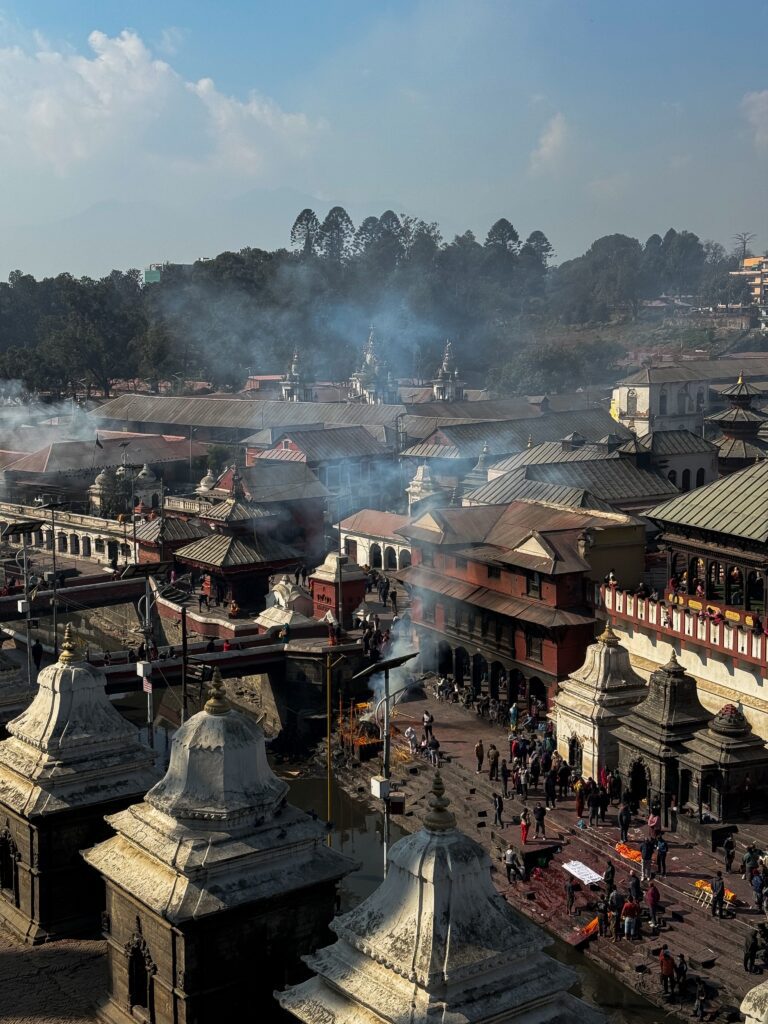
Among death rituals in Newari culture, the most significant ritual is the “Sagan“, which is performed on the fourth day after death. This ceremony includes offerings to the deceased and rituals to purify the family members. Cremation is typically conducted along the holy Bagmati River in Kathmandu, followed by a mourning period during which various rites are observed to honor the deceased and support their journey beyond this life.
The Janku is a series of life-cycle celebrations performed at different ages (77 years, 7 months, 7 days; 83 years, 4 months, 4 days; 88 years, 8 months, 8 days) to mark longevity. During the Janku, the person is honored with rituals that celebrate their life and wisdom, symbolically rebirthing them as a revered elder. The celebrant wears special clothes, is paraded around the town in a palanquin, and is treated with respect typically accorded to a deity.
Plan Your Trip to Nepal | Best Travel Resources
Book Your Accommodations
- Booking.com – the world’s leading online booking platform for accomodations around the world, they have an extensive amount of available listings with zero booking fees and best price guarantees.
- Hostelworld – a backpacker’s best friend, Hostelworld has the largest collection of hostels and guesthouses for affordable prices.
Don’t Forget Insurance
- SafetyWing – from Nomad Insurance, an insurance by nomads for nomads. They understand our lifestyle well and have really comprehensive and flexible plans that cater to any traveler.
Find Cheap Flights
- Kiwi.com – my go-to for booking and finding the cheapest flights and it’s helped me save tons of money. They do virtual interlining which is connecting flights from airlines that do not codeshare, so you can find routes that you wouldn’t be able to find normally.
Join Tours & Activities
- GetYourGuide – is one of the best places to find unique tours and activities. I found that it’s an excellent way to meet fellow travelers and create fond memories. They are not only limited to tours as they also offer niche services such as skip-the-line tickets or private transfers.
Catch a Ride
- Rentalcars.com – nothing beats the freedom of the road, Rentalcars.com is the world’s largest online car rental service. They operate across 160 countries so they’re the perfect partner to work with if you find yourself wanting a ride.




2 Responses
The Nepali monarchs tried very hard to erase Newari Culture but they failed because Newari Culture have deep roots ❤️
Indeed, it’s such a vibrant culture!